
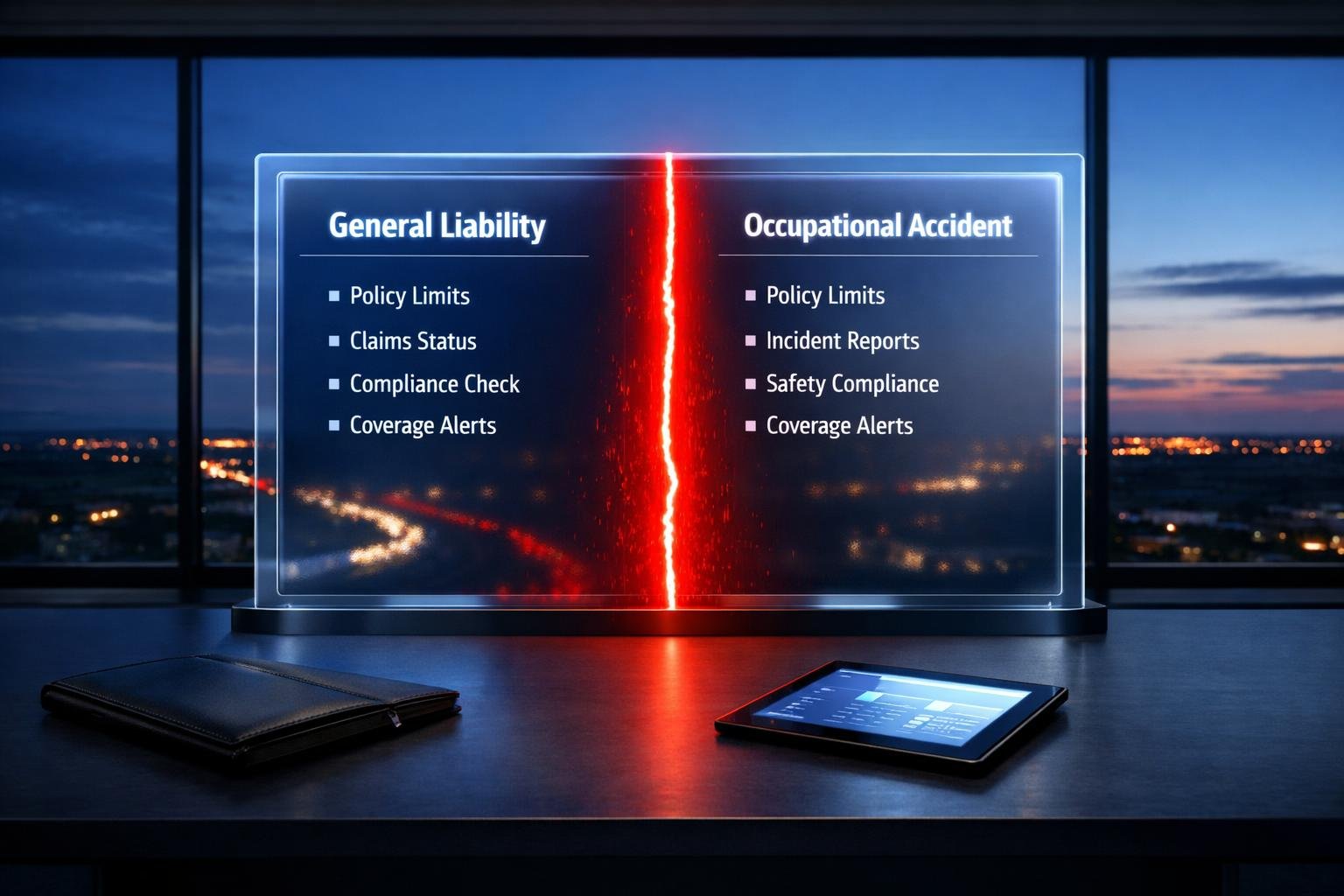
Every commercial producer has lived this scene. The client signs a fat GL policy, the certificate goes out, and three months later a 1099 contractor gets hurt on the job. The phone rings. The client wants to know which policy responds. You already know the answer: none of them do. Welcome to the general liability 1099 gap — the most expensive piece of empty space in the modern commercial book, and the single biggest reason agencies are losing accounts they thought were locked.
This is not a hypothetical. It’s happening on Monday mornings across every state. A staffing client deploys a 1099 nurse. A logistics client routes a 1099 cargo van driver. An MSP client contracts a 1099 network engineer for a weekend cutover. Somebody slips, crashes, or strains. The carrier denies. The client calls their attorney. The attorney calls their lobbyist. And the producer who wrote the GL policy gets blamed for a coverage hole that was never theirs to fill — until now.
Where General Liability Actually Stops
General Liability is built to protect the insured business from third-party bodily injury and property damage. Customer slips in the lobby. Cargo damages a loading dock. A subcontractor’s tool destroys a tenant’s HVAC. GL is the wall between the business and the public.
The wall does not extend inward. GL was never designed to respond when the injured party is part of the work itself — the contractor performing the job, the driver behind the wheel, the nurse on the floor. Employee Benefits Liability won’t touch it. Hired & Non-Owned Auto won’t touch it. Commercial Umbrella sits on top of policies that don’t trigger in the first place. The exposure isn’t a rider. It’s a category.
The General Liability 1099 Gap: What It Costs Your Client
The general liability 1099 gap shows up in three places, and your client gets buried in all three.
- The medical bill. A 1099 contractor with no occupational coverage owns their own injury. They typically don’t. They turn to the hiring entity.
- The lawsuit. Plaintiff counsel argues misclassification — the worker was a de facto employee, the hiring entity owed them coverage, and the absence of that coverage is itself the breach. The negligence theory writes itself.
- The DOL audit. Once a worker files a claim that names the hiring entity as the responsible party, regulators get curious. The Department of Labor doesn’t need a Wage and Hour complaint to start a misclassification inquiry. The claim is the complaint.
This is what we call the Invisible Risk. It doesn’t appear on the loss runs. It doesn’t show up in the carrier’s submission packet. It doesn’t get flagged in the standard COI review. It only appears the moment a contractor gets hurt — and by then the agency that should have raised the flag is the one explaining to a furious client why nobody mentioned it at binding.
Why Workers’ Comp Isn’t the Answer
Producers reflexively reach for Workers’ Comp here. It is the wrong tool. Workers’ Comp is for W-2 employees. The WORK Program is for the 1099 economy. They are legally distinct tools for legally distinct workforces.
Writing WC on a contractor population doesn’t just fail mechanically — it creates a worse problem. If a state auditor sees Workers’ Comp premium being paid on workers your client classified as 1099, they have all the evidence they need to argue your client treated those workers as employees. You’ve handed the regulator the misclassification finding for free. The audit isn’t the fine. The audit is the event — and you accelerated the event by stapling the wrong product to it.
Occupational Accident Insurance solves the underlying problem. It pays for the contractor’s medical and lost-time exposure without creating a W-2 evidentiary trail. It preserves the contractor relationship while closing the financial gap that turns a sprained ankle into a six-figure lawsuit.
How the WORK Program Closes the Gap
The WORK Program, distributed through 1099 Protect, sits inside the gap and fills it. We’re the program provider; your agency distributes the product. Three things happen the moment the policy binds.
First, the contractor has real coverage. Medical, accidental death and dismemberment, temporary total disability. When they’re hurt, they call a number, file a claim, and the bills stop flowing toward your client’s GL underwriter.
Second, your client builds a Compliance Firewall. The act of providing Occupational Accident coverage to the contractor population is itself a piece of the misclassification defense. It’s a documented paper trail of contractor independence — your client treated the workers as the independent contractors they are, and offered them an industry-appropriate safety net. When the DOL knocks, that paper trail is the difference between a citation and a closed file.
Third, the program runs at the speed the modern book demands. Quote and bind happens in hours, not days. Billing is real-time, pay-as-you-go through our Compliance Firewall architecture, and the 3% credit card and ACH processing fees are legally passed to the insured — your client reclaims revenue your competitors are still absorbing.
The Agency Play: Three Conversations That Open the Door
You don’t need to reposition the book to monetize this. You need three conversations.
Conversation one: the renewal. Every commercial client with 1099 spend on their books is sitting on the gap. Pull the 1099-NEC totals at renewal and ask: “Who is responding when one of these workers gets hurt?” The silence is the sale.
Conversation two: the new logo. The producer who walks in with the gap diagnosis wins the account. The incumbent didn’t bring it up. You did. That is the move.
Conversation three: the cross-sell. Existing healthcare staffing, last-mile logistics, IT services, professional services, and trucking accounts in your book all carry the exposure. Healthcare clients route to our Healthcare lane; DSP and last-mile to our Last Mile lane; trucking and owner-operator to our Trucking lane. Each one is a new revenue line on existing relationships.
Audit Immunity Is a Sellable Outcome
The word your client is buying is not “insurance.” The word is Audit Immunity. Your client is buying the right to keep operating their 1099 model without lying awake at night waiting for the DOL letter, the worker complaint, or the plaintiff’s demand letter. You are the producer who can sell that outcome because you are the one who saw the gap.
What This Means for Your Book
The agencies winning right now are not the ones writing the cheapest GL. They are the ones diagnosing the general liability 1099 gap before the contractor gets hurt. You walk in, you ask the 1099 question, you write the WORK Program alongside the GL renewal, and you turn a liability into a defense. The account gets stickier. The premium grows. The defensibility against client losses caused by uninsured misclassification becomes part of why your shop is irreplaceable.
The producers who don’t have this in their toolkit are already losing those accounts. They just don’t know yet.
Get Appointed
If your agency isn’t appointed to write the WORK Program, the gap conversation is academic. Start the appointment process here. Quote and bind in hours, white-label collateral for your shop, and a program team that supports the conversation from diagnosis through claim. The WORK Gap is open across your entire commercial book right now. The question is which producer in your market closes it first.