
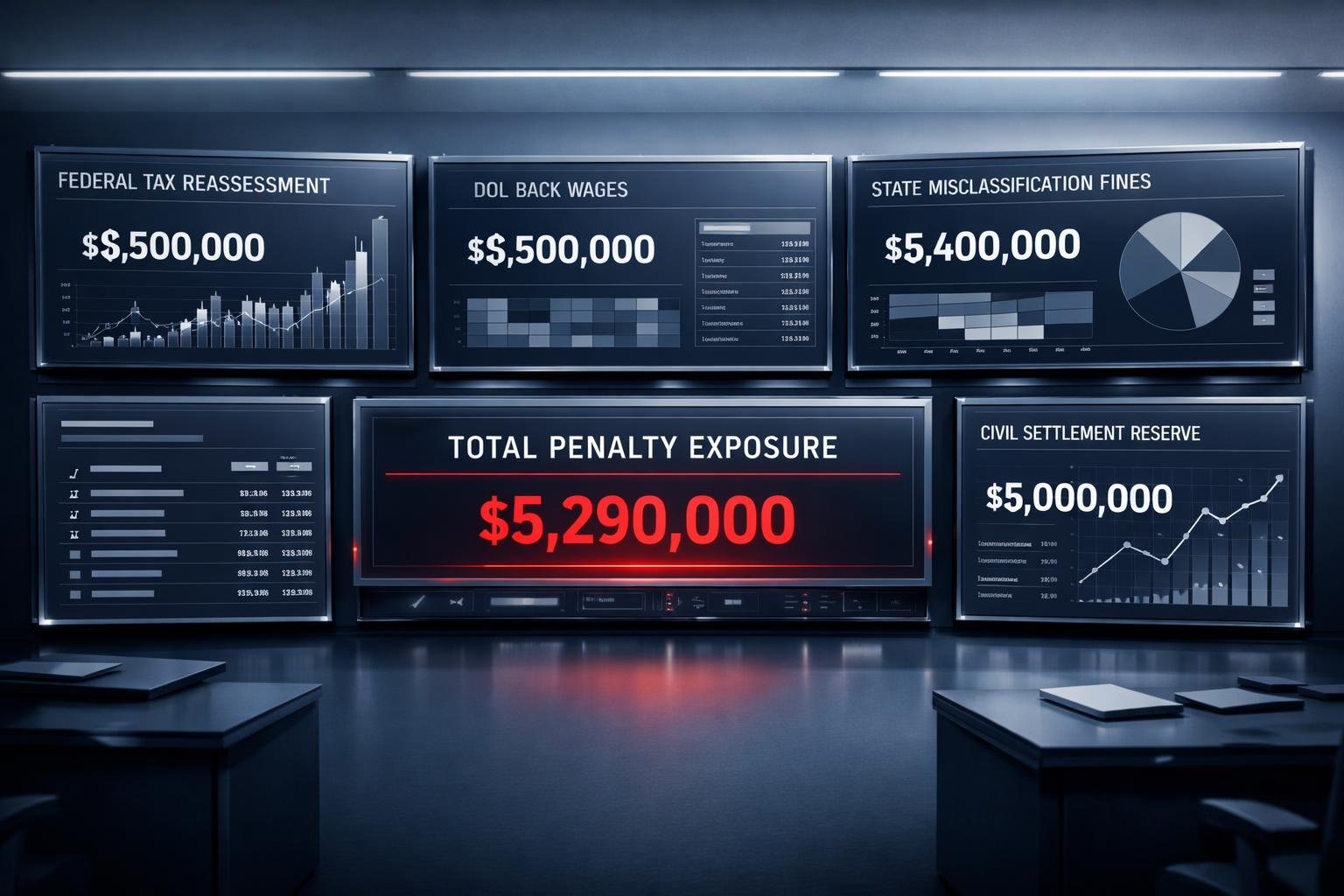
The 1099 misclassification cost facing American businesses in 2026 is no longer a theoretical line item — it is one of the fastest-growing categories of unbudgeted operating loss in the country. The Department of Labor (DOL), IRS, and state labor boards have aligned enforcement priorities, and the math is now overwhelming: a single audit on a mid-sized contractor roster routinely produces six- and seven-figure liabilities that did not exist on the company’s books the day before the auditor walked in.
This guide breaks down the actual penalty stack — federal, state, and civil — that a hiring entity inherits the moment a 1099 worker is reclassified as a W-2 employee. We walk through real numbers, real statutes, and a practical compliance posture that turns a balance-sheet wildfire into a fixed, predictable expense.
What Triggers the 1099 Misclassification Cost in 2026
Every 1099 misclassification cost begins with a triggering event. The most common in 2026 are:
- A single former contractor filing an SS-8 determination request with the IRS
- A state unemployment claim filed by a 1099 worker after a layoff or termination
- A workers’ compensation claim filed by a contractor who suffered a job-site injury
- A targeted DOL Wage & Hour Division audit driven by industry-specific enforcement initiatives
- A whistleblower complaint under state-level worker classification statutes (now active in 18 states)
The economic damage is rarely confined to the worker who triggered the audit. Once an investigator concludes that a single contractor was misclassified, the agency presumes that all similarly situated workers — your entire 1099 roster — were misclassified the same way. This is the multiplier that turns a $5,000 dispute into a $500,000 reassessment overnight.
The Federal Tax Component: IRS Penalty Math
When the IRS reclassifies 1099 contractors as employees, the hiring entity becomes retroactively liable for unpaid employment taxes plus a stacking penalty schedule. Under IRC §3509, a good-faith reclassification carries:
- 1.5% of wages paid as the federal income tax withholding the employer should have remitted
- 20% of the employee’s share of FICA (Social Security plus Medicare)
- 100% of the employer’s FICA share at 7.65%
- Federal Unemployment Tax (FUTA) at 0.6% on the first $7,000 of each worker’s wages
If the IRS finds intentional misclassification — meaning the company should have known the workers were employees — those rates double:
- 3% of wages for federal income tax withholding
- 40% of the employee’s share of FICA
On a 25-contractor roster paying $60,000 each annually, intentional misclassification produces roughly $360,000 in pure federal tax liability before any administrative penalties or interest are applied.
Stacking Failure-to-File Penalties
On top of the tax bill, the IRS imposes administrative penalties for the W-2s and 941s that were never filed:
- $310 per unfiled W-2 in 2026 (up from $290 in 2025)
- $310 per W-2 with incorrect information — the same workers reclassified now require corrected forms
- $60 to $630 per missed quarterly Form 941, depending on lateness
- Interest at the federal short-term rate plus 3%, compounding daily from the original due date
For a 25-worker roster across three audit years, the W-2 penalty alone is approximately $23,250. Add the 941 stack and you are over $30,000 before back taxes are even calculated.
The DOL Component: Wage and Hour Violations
The Department of Labor’s Wage & Hour Division operates an entirely separate penalty track. Once workers are reclassified as employees, every dollar paid below an applicable minimum wage, every overtime hour worked, and every meal-break violation becomes an actionable claim. The DOL recovered $213.6 million in back wages in fiscal 2025 — a record — and 1099-driven cases accounted for a disproportionate share of that recovery.
Back Wages and Liquidated Damages
A misclassified contractor who worked 50 hours per week for two years can claim:
- Back overtime wages at 1.5x the regular rate for every hour over 40
- Liquidated damages equal to the back wages, effectively doubling the bill
- Civil money penalties up to $2,569 per violation for willful or repeated infractions
- Attorney’s fees and costs awarded to the prevailing worker under the Fair Labor Standards Act
Across a 25-person roster, FLSA exposure alone routinely exceeds $400,000 — a number we have seen settle in the wild on cases reviewed inside our underwriting partner network during 2025.
The State Penalty Stack: Where the Bill Triples
The federal exposure is only the foundation. Every state runs its own audit triggers and its own penalty schedule, and most run them concurrently with the IRS and DOL.
California: The Bellwether for AB-5 States
California’s misclassification regime is the most punishing in the country:
- $5,000 to $15,000 per misclassified worker (first violation)
- $10,000 to $25,000 per worker (subsequent violations)
- Unpaid Employment Development Department contributions plus 50% penalty
- Workers’ compensation premium fraud charges, a felony exposure under §3700.5
New York and New Jersey: The Construction Tripwire
Both states have extended their construction-industry misclassification statutes to logistics, healthcare staffing, and IT contractors. Penalties run $1,500 to $5,000 per worker per quarter, with criminal referral after the second offense.
Texas, Florida, and the Audit Gap Myth
Many operators assume non-AB-5 states like Texas and Florida are safe. They are not. The Texas Workforce Commission’s 2025 enforcement report shows a 41% year-over-year increase in 1099 misclassification audits, and Florida’s Department of Economic Opportunity now runs random audits on any business reporting 10 or more 1099-NEC forms.
The Civil Lawsuit Multiplier
Beyond government penalties, misclassified workers — and their attorneys — increasingly pursue private civil action. A single class-action filing can multiply exposure tenfold:
- Wage and hour class actions in 2025 averaged $4.3 million per settlement
- Misclassification claims now appear in roughly 1 in 6 employment lawsuits filed in federal court
- State PAGA-style statutes (now active in 9 states) allow workers to collect penalties on behalf of the state, with private attorney fees attached
The plaintiff’s bar has industrialized this work. A misclassified-worker complaint can be filed for under $2,000 in fully-loaded cost — and the upside on settlement is a contingency fee on a seven-figure award. The economics are not in the hiring entity’s favor.
Putting the Math Together: A Realistic 25-Worker Audit
Here is a conservative composite based on real 2025 to 2026 enforcement actions reviewed by our compliance team:
- IRS back taxes (intentional reclassification): $360,000
- IRS administrative penalties (W-2 plus 941): $32,000
- FLSA back wages and liquidated damages: $410,000
- State misclassification penalties (median state): $145,000
- Workers’ compensation premium reassessment: $87,000
- Legal defense and settlement reserve: $250,000
Total exposure: approximately $1.28 million on a roster that generated roughly $1.5 million in contractor payments. The misclassification penalty effectively erases the entire labor budget for the audit period.
Why Occupational Accident Insurance Is the Compliance Firewall
The most overlooked driver in the stack above is workers’ compensation premium fraud — and it is also the easiest single category to neutralize. By placing a properly-structured Occupational Accident Insurance (OAI) policy on every legitimate 1099 contractor, hiring entities create three protective layers at once:
- An economic record demonstrating the contractor was not treated as an employee dependent on the hiring entity for safety-net coverage
- A first-dollar medical and disability benefit that resolves the most common audit-trigger event — an injury claim — before it becomes a state filing
- A documented, paper-trail commitment to contractor-class risk management that satisfies the economic realities test the DOL uses to evaluate classification
Critically, OAI is not a substitute for workers’ compensation. W-2 employees receive workers’ compensation. 1099 independent contractors receive OAI. They are legally distinct products covering legally distinct populations. Conflating them is exactly what triggers the audits described above. 1099 Protect is built specifically to keep this line clear and defensible.
The Agent Opportunity
For commercial agents, the misclassification cost story is the highest-leverage cross-sell available in 2026. Every business client with 10 or more contractors is sitting on a balance-sheet wildfire — and OAI is the single product that converts that exposure into a fixed monthly premium. Our agent program is structured around speed: real-time quoting, same-day binding, and a back office that handles the certificate-of-insurance traffic so the agent can focus on production.
The Bottom Line
The 1099 misclassification cost in 2026 is not a tail risk. It is a probability event — and the math is so lopsided that a single audit consumes an entire year of contractor labor budget. The companies that survive the next enforcement cycle will be the ones that either move every contractor to W-2 (an operational and tax disaster) or build a defensible OAI-anchored compliance posture before the audit notice arrives.
The audit is cheaper to prevent than to fight. Speak with 1099 Protect today about quoting your contractor roster — most placements bind within hours, not days, and the policy structure is engineered specifically to defeat the misclassification penalty stack described above.