
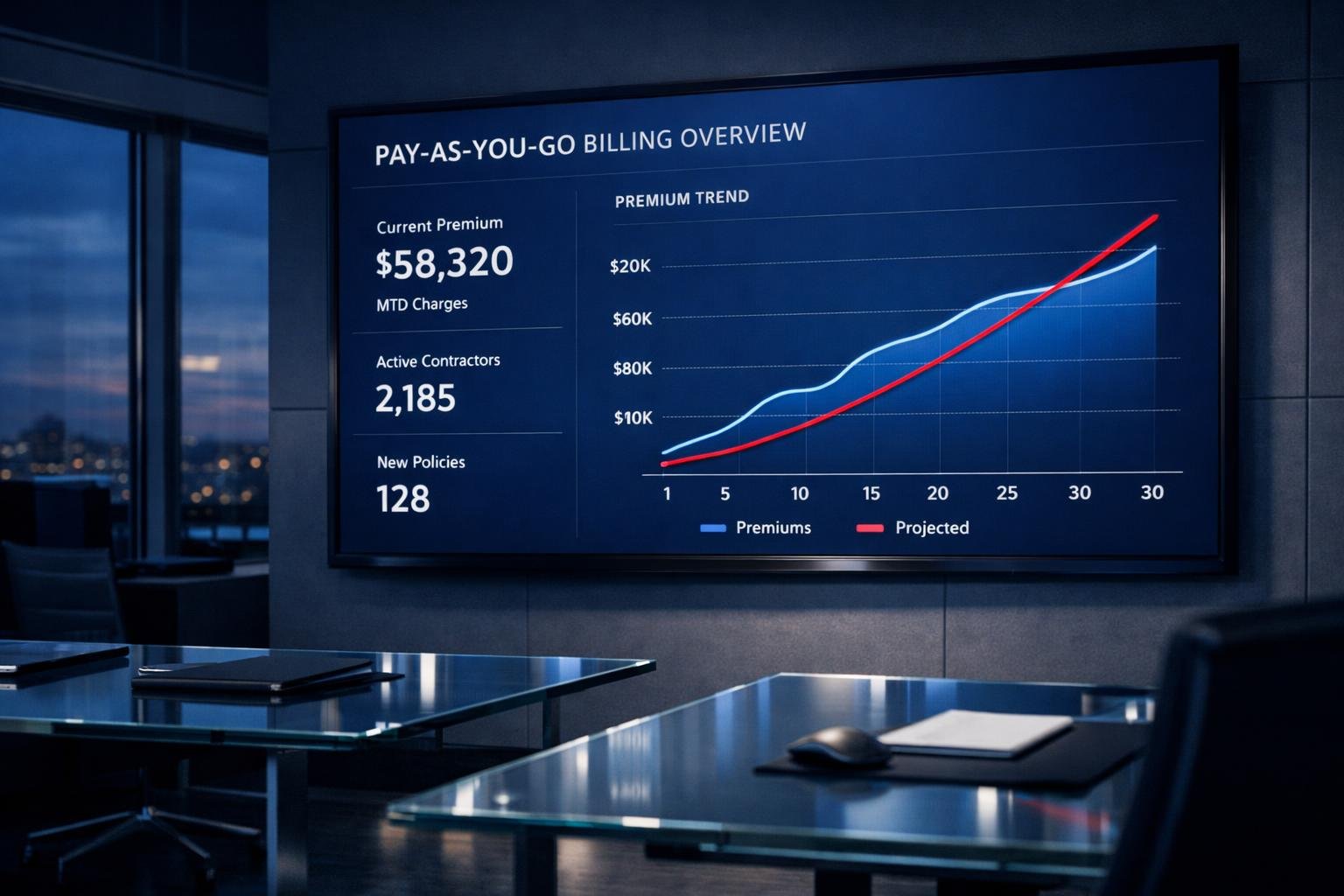
For most of the last century, the rhythm of commercial insurance was annual. You bound a policy on an estimate, the client paid a deposit premium, and twelve months later an auditor reconciled the guess against reality and sent a bill nobody enjoyed. That model is now coming apart, and real-time insurance billing is the force pulling it down. For agencies that distribute coverage to workforces that change week to week, the shift is not a back-office detail. It is the single biggest change in how your revenue arrives, how your accounts stay, and how fast you can stand up a new line.
This is an operator’s read on where distribution is heading over the next few years, and why the agencies that move early on real-time rails will own the 1099 economy on their books.
Why Real-Time Insurance Billing Is Replacing the Annual Audit
The annual premium audit exists because the old systems could not see a workforce as it actually moved. A staffing firm with forty contractors in January and ninety by June was a billing problem the carrier solved after the fact, with a reconciliation, a true-up, and a payment dispute. Every step of that was friction the agency absorbed in service hours and strained renewals.
Real-time billing inverts the whole sequence. Instead of estimating exposure up front and arguing about it later, the platform meters coverage as the workforce changes and bills against what is actually live. A participant comes on this week, the system reflects it. A contract winds down, the system reflects that too. There is no year-end surprise because there was never a year-long guess. For the insured, the bill matches the business. For the agency, the account stops generating the kind of billing tension that quietly erodes retention.
The trucking and last-mile worlds saw this first because their workforces are the most volatile, but the logic now applies to nearly every book carrying sustained 1099 engagement — healthcare staffing, IT consultancies, professional services, install and delivery networks. Wherever the headcount breathes, pay-as-you-go is simply the honest way to bill it.
What Pay-As-You-Go Changes for the Agency
The temptation is to read real-time billing as a feature that benefits only the end client. It does not. It rewires the economics of the agency seat in three concrete ways.
First, it changes cash rhythm. Premium flows as exposure flows, which means a growing account grows your commission base in real time rather than at a once-a-year reconciliation you cannot forecast. Second, it removes the audit as a service burden. The hours your team spends fielding true-up disputes become hours spent writing new business. Third, and least appreciated, it makes the account stickier. An insured who can see their bill track their actual workforce has far less reason to shop — the product is doing something their old carrier’s annual model never could.
Phone-First Enrollment Is the Other Half of the Shift
Real-time billing only works if enrollment is fast enough to keep up with it, and that is where the second structural change is happening: distribution is going phone-first. The paper application — printed, signed, scanned, emailed, keyed in days later — was built for a world where coverage was annual and slow was acceptable. It cannot serve a workforce that changes weekly.
The modern enrollment path is a co-branded page the worker completes from a phone in minutes, with the producer’s information already pre-filled and the quote and bind happening in hours rather than days. We have watched this play out in the most literal way possible: an agency sent us a logo Tuesday morning, and Tuesday afternoon their branded enrollment page was taking applications. That is the cadence the next decade of distribution runs on, and it is the cadence real-time billing demands.
For agencies thinking about how to position their own shops, the lesson is that speed-to-enroll and speed-to-bill are now the same competitive surface. You cannot meter a workforce in real time if it takes four days of paperwork to add a participant. The platforms that win are the ones where enrollment, binding, and billing are a single continuous motion. You can see how that motion looks from the agency seat on our agency solutions overview.
Co-Branded Distribution Becomes the Default, Not the Upgrade
The third trend worth naming is the collapse of the wall between the program provider and the agency’s brand. For a long time, white-labeling was a premium favor a carrier might extend to its largest partners. That is ending. The expectation now is that the agency’s logo, colors, and producer sit on the front of every storefront and every piece of collateral, while the program rails run invisibly behind.
This matters because distribution is a brand business. When a client enrolls through a page that looks like the carrier and not like your agency, you have handed your relationship — and your renewal leverage — to someone else’s logo. Co-branded distribution keeps the agency at the center of the account, which is exactly where retention lives. A modern program ships the storefront and the print-ready collateral on day one, not as a custom project but as the standard package. Agencies can spin up co-branded sales material directly through tools like our custom sales sheet generator.
The Fee Pass-Through Nobody Talks About
There is a quieter economic shift riding alongside all of this. Real-time, digital billing makes it trivial to pass the 3% credit card and ACH processing fee legally to the insured rather than eating it. On the old paper-and-deposit model, that fee was a line item the agency or carrier swallowed. On modern rails, it becomes a clean, compliant recovery — a new margin line that simply did not exist in the annual-audit world. Multiply that across a book and the difference between the old model and the new one is not a convenience. It is revenue.
What This Means for the Agency Deciding Where to Place
Put the three trends together — real-time billing, phone-first enrollment, co-branded distribution — and a clear picture of the next few years emerges. The agencies that thrive will be the ones placing 1099 workforce coverage through platforms built for motion: coverage that meters as the workforce changes, enrollment that happens on a phone in minutes, and a storefront that carries the agency’s own brand from the first click.
The agencies that struggle will be the ones still tethered to incumbents running annual estimates, paper applications, and state-by-state endorsements on a workforce that no longer holds still. The gap between those two postures is going to widen fast, because the underlying technology compounds. Once an insured experiences a bill that matches their actual business, the annual true-up looks like what it is — a relic.
None of this requires a leap of faith. Multiple agencies are already live on real-time rails, onboarding the same day they decide to move and writing 1099 coverage across trucking, healthcare, last-mile, and professional services without a state-by-state fight. The infrastructure exists. The only open question is which agencies position themselves on it before their competitors do.
The Honest Framing on Workforce Coverage
One clarification matters here, because it is constantly muddled. Real-time Occupational Accident Insurance is not a cheaper version of Workers’ Comp, and it is not a substitute for it. Workers’ Comp is for W-2 employees. The WORK Program is for the 1099 economy. They are legally distinct tools for legally distinct workforces. The reason real-time billing fits Occupational Accident Insurance so naturally is that the 1099 workforce is the one that actually moves week to week — which is exactly the workforce the annual-audit model was worst at serving.
For agencies, that distinction is the opening. The book you already write almost certainly contains accounts with sustained 1099 engagement that nobody has placed coverage on, because the old rails made it more trouble than it was worth. Real-time billing removes that friction. The coverage becomes a clean add, the billing tracks itself, and the account gets stickier in the process.
The Move
The annual premium audit had a long run. It is ending because the workforce it was built to measure stopped holding still, and the technology to bill honestly in real time finally caught up. Agencies that distribute 1099 workforce coverage on modern, real-time rails will spend the next decade taking accounts from the ones that did not. If you want to see what going live on those rails looks like from the agency seat — co-branded storefront, phone-first enrollment, real-time billing, all of it standing up the same week — get appointed and we will walk you through the machine.