
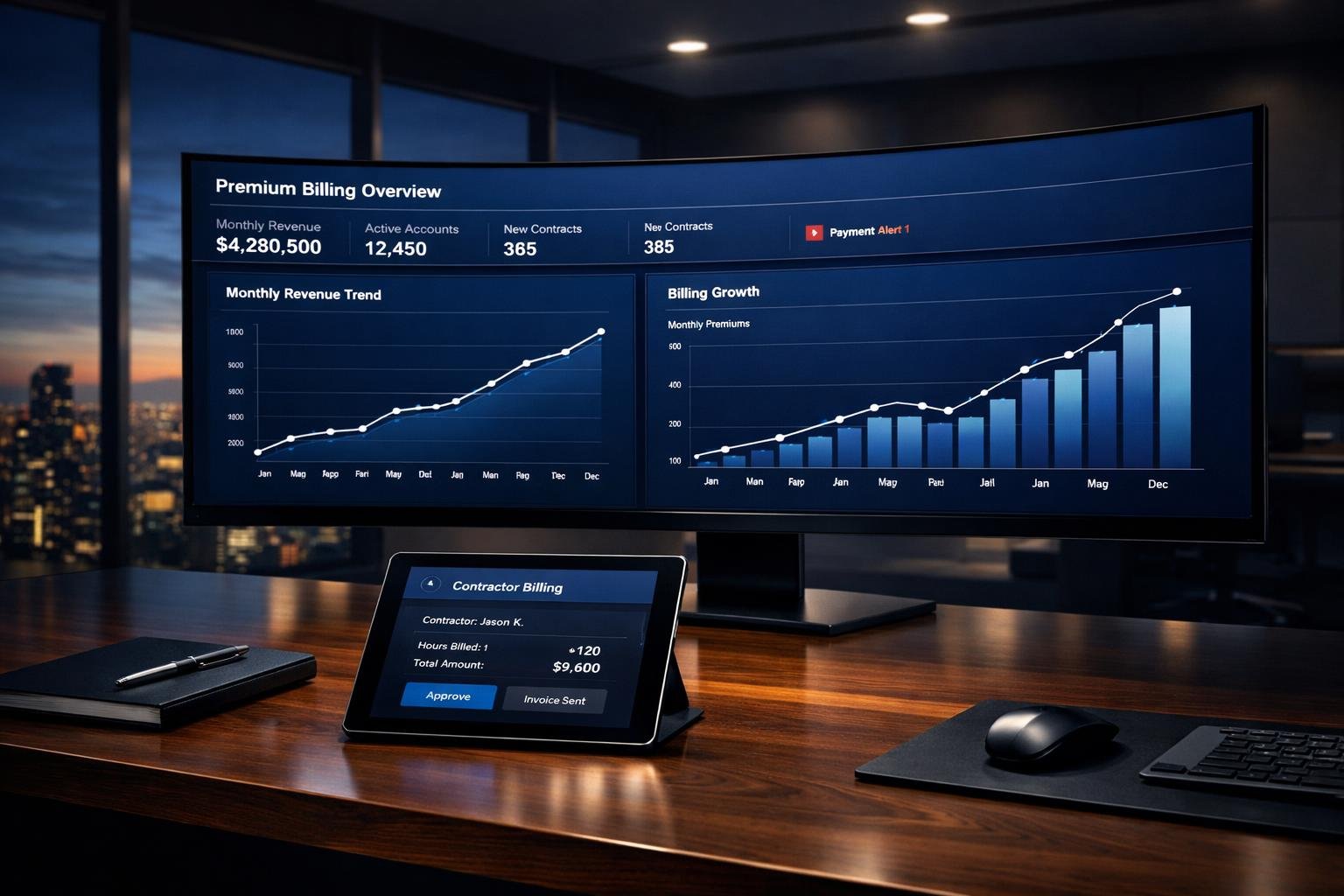
If you are still paying for occupational accident coverage the way agencies sold it in 2005, you are quietly handing your competitors a margin advantage. Pay-as-you-go OAI billing is the modern alternative to the annual deposit, year-end audit, and surprise reconciliation cycle that has defined this product for two decades. It bills coverage the same way payroll runs: in real time, against actual headcount, with no upfront lump sum and no twelve-month guess about how many 1099 contractors you will engage.
The traditional annual premium model was built for an era of stable W-2 payrolls and predictable rosters. It does not fit a 1099 workforce that turns over weekly, scales by route or shift, and lives in spreadsheets that change every Monday morning. The result for hiring entities is the same cash-flow drain we see across every vertical we serve at 1099 Protect: capital trapped in deposits, surprise audit invoices that arrive months after a project ends, and a coverage decision that has to be re-litigated every renewal.
How Traditional Annual OAI Premiums Drain Cash Flow
The legacy model is straightforward in design and brutal in execution. A hiring entity estimates the number of 1099 contractors it expects to engage over the next twelve months. The carrier multiplies that count by a per-head rate, applies a minimum premium, and demands a deposit. The deposit is rarely refundable. Twelve months later, an auditor pulls 1099 records, recalculates exposure, and sends an additional invoice for any over-utilization. Under-utilization rarely generates a refund.
Three structural problems compound from there.
The Deposit Problem
Most legacy OAI programs require 25% to 50% of the annual premium upfront. For a logistics company running 80 last-mile drivers at $45 per head per month, the annual premium is roughly $43,200. The deposit alone can exceed $20,000 — capital that sits on a carrier’s balance sheet for a year, earning the carrier interest, not yours. That is working capital you could be deploying into driver acquisition, equipment, or retention bonuses.
The Audit Surprise Problem
Year-end audits routinely produce invoices that are 15% to 40% higher than the original premium because hiring entities consistently under-estimate their actual contractor turnover. The audit invoice lands six to ten weeks after the policy term ends, often after the budget for that year has already closed. CFOs hate this. Operations leaders hate this even more, because the audit invoice often arrives after the contractors who generated the exposure have already been paid out and offboarded.
The Reconciliation Problem
Disputing an audit is expensive. The hiring entity must produce 1099 records, contractor agreements, and project timelines to argue that exposure was lower than the auditor calculated. This consumes hours of CFO and operations time and rarely results in a meaningful reduction. The path of least resistance is to pay the invoice and move on, which is exactly what carriers count on.
What Pay-As-You-Go OAI Billing Actually Does
Pay-as-you-go OAI billing inverts the structure. Instead of estimating exposure annually, the hiring entity reports active 1099 contractors on a recurring basis — typically monthly, but in some configurations weekly or per-engagement. Premium is calculated on actual headcount and billed automatically through ACH or card on file. There is no annual deposit. There is no year-end audit. There is no reconciliation invoice.
This is the billing model we built into the 1099 Protect WORK Program. It is not a billing convenience layered on top of a legacy product — it is a structurally different product. The carrier accepts real-time exposure data as the source of truth, which means hiring entities pay for what they actually used, not what they guessed they would use.
Real-Time Headcount Scaling
When a logistics company adds 12 drivers for a peak season surge in November, the November invoice reflects 12 additional drivers. When those drivers offboard in January, the January invoice drops accordingly. There is no rate adjustment, no endorsement, and no audit reconciliation later. The invoice is the audit.
No Upfront Deposit
The hiring entity keeps its working capital. For a 200-contractor operation, that frequently means $50,000 to $100,000 in cash that stays on the company’s balance sheet instead of the carrier’s. Over a typical three-year program, the cumulative working-capital benefit can fund an entire operations hire.
Predictable Monthly Cost
Finance teams can model OAI as a per-contractor variable cost rather than an annual fixed expense. This makes the product easier to allocate to project budgets, easier to pass through in client contracts, and easier to defend in board reviews. It also makes the product easier for agents to sell, because the conversation is no longer about a five-figure check.
Why This Matters for Compliance, Not Just Cash Flow
Pay-as-you-go OAI billing has a second-order benefit that legacy carriers rarely advertise: it produces a clean, time-stamped record of every 1099 contractor who was covered on every day of the policy period. That record is exactly what a Department of Labor auditor asks for during a misclassification investigation.
Under the traditional annual model, hiring entities often cannot produce this record. They know how many 1099s they had at the start of the year. They know how many they had at the end. The middle is often a fog of contractor agreements, onboarding documents, and offboarding paperwork stored in three different systems. When the DOL asks for proof that a specific contractor was covered on a specific day, the hiring entity scrambles.
Real-time billing creates the audit trail automatically. Every invoice is a snapshot of who was covered. Every change is a documented event. This converts a billing system into a compliance asset — and it is a meaningful piece of the Compliance Firewall that defends a hiring entity from misclassification exposure.
The Agent Conversation: Replacing the Annual Premium Pitch
For agents, the pay-as-you-go model changes the sales motion entirely. The legacy pitch required convincing a prospect to write a five-figure check, accept a year-end audit, and trust that the carrier would not surprise them. Most prospects said no, or they delayed the decision until renewal pressure forced a quick close.
The pay-as-you-go pitch is materially different. Agents are now selling a per-contractor monthly fee with no deposit and no audit. Decision velocity accelerates. Close cycles compress from weeks to days. The product becomes easier to bundle with other coverages because it is no longer competing for a large slice of the same renewal budget.
Agents working with 1099 Protect typically report that pay-as-you-go billing closes deals that would have stalled under the legacy model — particularly with logistics, healthcare staffing, and IT services accounts where 1099 headcount is volatile and finance teams resist large upfront commitments.
What to Look for in a Pay-As-You-Go OAI Program
Not every program marketed as pay-as-you-go actually delivers the structural benefits described above. Some carriers offer monthly billing on top of a legacy annual premium calculation, which preserves the deposit and audit surprise while changing only the cadence of payment. That is not pay-as-you-go. That is monthly installments on the same broken product.
A genuine pay-as-you-go OAI program should answer yes to all of the following. Premium is calculated on actual reported headcount, not annual estimate. There is no upfront deposit beyond the first month. There is no year-end audit reconciliation. Coverage scales up and down with reported contractors in real time. The carrier accepts real-time exposure data as the source of truth for billing.
If a program fails any of those tests, the hiring entity is paying for the appearance of modern billing without the underlying structure that produces the cash-flow and compliance benefits.
Bind Coverage in Hours, Not Days
The 1099 Protect WORK Program was designed from the billing layer up to deliver real pay-as-you-go OAI billing for hiring entities running 1099 contractor workforces. Quote and bind times are measured in hours, not days. There is no upfront deposit. There is no year-end audit. Coverage scales with headcount. The billing record doubles as a compliance audit trail.
If your current OAI program still requires a five-figure deposit and a year-end audit, you are paying twice — once in cash flow and once in compliance exposure. Talk to a 1099 Protect specialist and see what the modern billing model looks like in production.