
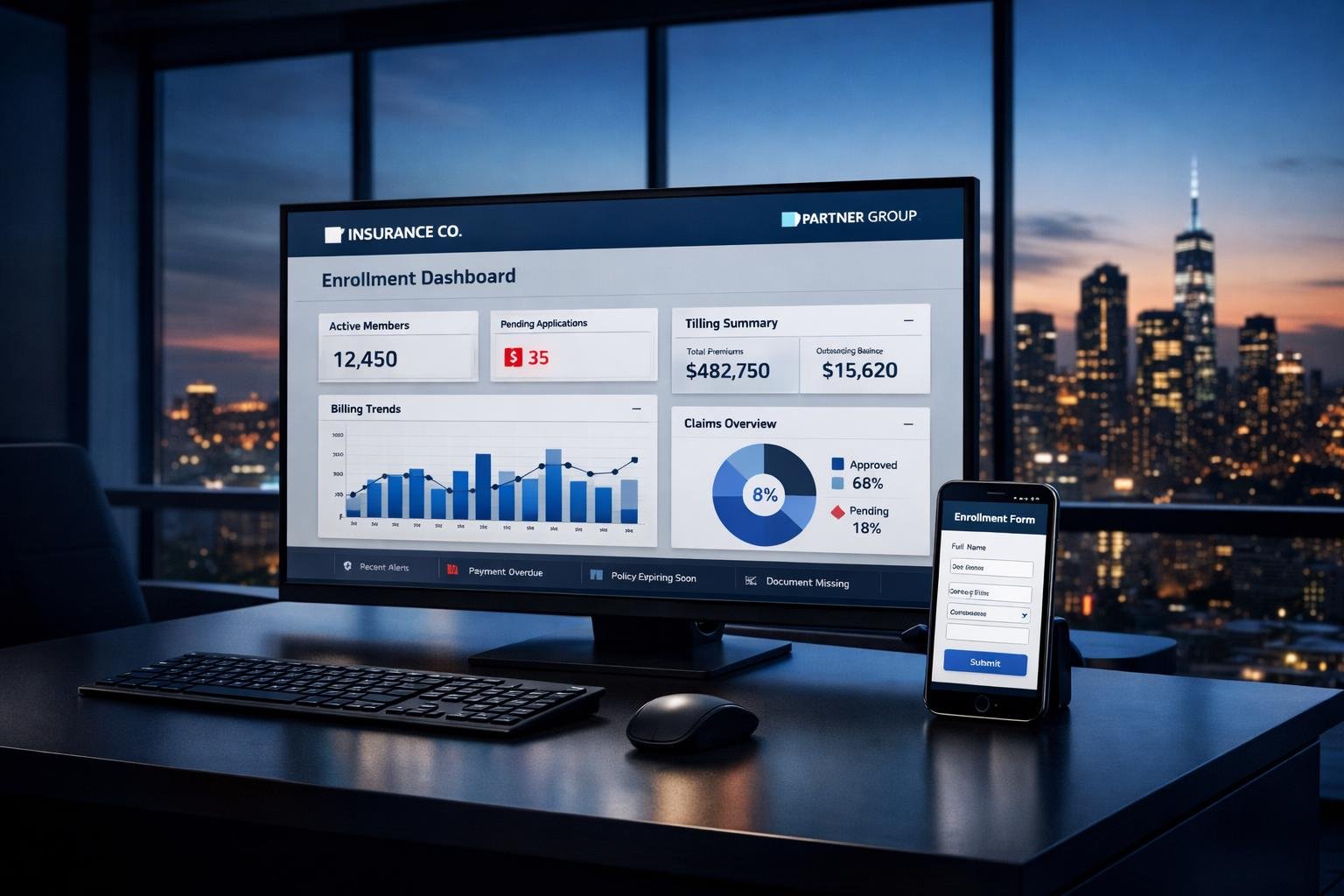
Ten years ago, placing Occupational Accident Insurance meant a producer, a paper application, and a fax machine. The agency’s name never touched the product. The client waited days for a bind. The billing arrived as a once-a-year premium audit that nobody enjoyed. That model is ending, and the agencies paying attention are already moving. The future of co-branded insurance distribution is not a slide in a carrier deck. It is a working set of rails that put your brand on the front and let coverage bind in hours.
This is an operator’s view of where 1099 workforce coverage and the distribution around it are headed over the next decade, and what it means for the agency principal reading this who wants to grow without adding back-office headcount.
Co-Branded Insurance Distribution Stops Being a Favor and Becomes the Default
For most of the industry’s history, white-labeling was a courtesy carriers extended to their largest partners. A national agency with leverage could get its logo on a brochure. Everyone else distributed the carrier’s brand and hoped the client remembered who sold the policy. That asymmetry is collapsing because the cost of standing up a branded storefront has gone to near zero.
The agencies winning new 1099 business now operate their own enrollment pages, their logo, their colors, their producer pre-filled on every form, live in a day. An agency sent us a logo Tuesday morning. Tuesday afternoon their branded enrollment page was taking applications. That is not a future capability. It is the current baseline, and within a few years it will be the expectation every commercial client brings to the table. When your client can enroll their independent contractors on a page that carries your name, the relationship stops leaking to the carrier and stays with you.
For agencies thinking about how this plugs into an existing book, the mechanics of agency distribution for 1099 workforce coverage are already documented and running with multiple agencies live on the platform today.
Phone-First Enrollment Replaces the Paper Application
The single biggest friction point in placing coverage on a 1099 workforce has always been the application. A field full of independent drivers, traveling nurses, or last-mile installers does not sit at a desk with a printer. They have a phone. For two decades the industry asked them to behave like office workers, print this, sign that, fax it back, and then wondered why enrollment lagged.
Phone-first enrollment inverts that. The participant, the driver, the 1099 worker, completes a mobile application in minutes, from wherever they are. The account owner, the hiring business, gets visibility without chasing paperwork. The producer gets a clean, structured submission instead of a smudged PDF. This is not a cosmetic upgrade. It is the difference between an account that enrolls eighty percent of its contractors and one that enrolls twenty and quietly lets the rest go uncovered.
Why This Matters for the Agency, Not Just the End User
Every percentage point of enrollment completion is premium that either lands on your book or evaporates. When the application is phone-native, completion rates climb, and the agency that distributes the easier process wins the account against the agency still mailing forms. Distribution advantage compounds: the smoother your enrollment, the more your existing clients refer, and the faster you close the next logo.
Real-Time Billing Ends the Annual Premium Audit Era
Pay-as-you-go is the quiet revolution. The traditional premium audit, estimate the exposure up front, true it up a year later, send the client a surprise bill or a grudging refund, is a relic of a world without real-time data. It creates friction at renewal, it strains the client relationship, and it puts the producer in the uncomfortable position of defending a number nobody can verify until it is too late.
Real-time, usage-based billing closes that gap. Coverage scales with the actual 1099 workforce as it grows and contracts, week to week. There is no year-end reckoning because the exposure was always current. For the agency, this removes the single most common renewal argument and replaces it with a billing experience the client actually trusts. Over the next decade, the agencies that still defend annual audits will be explaining to clients why their coverage works like it is 2010.
The Fee Pass-Through Becomes a New Revenue Line
Here is the part most agencies have not priced into their thinking. Processing fees on credit card and ACH payments, historically a cost the agency or carrier absorbed, can now be legally passed to the insured. A 3% pass-through on payment processing is not a rounding error across a book of recurring 1099 premium. It is a standing revenue line that requires no new back office, no new staff, and no change to how the client experiences the product.
This is where the conversation about distribution stops being about convenience and starts being about margin. The agencies that adopt co-branded, real-time rails are not just retaining more business, they are monetizing the plumbing itself. That is a structural advantage their competitors cannot match by working harder.
All-States Coverage Without the Endorsement Treadmill
The other quiet shift is geographic. A staffing client with contractors in eleven states, a delivery operation scaling across regional hubs, a healthcare network placing travelers nationwide, these accounts historically meant a state-by-state endorsement grind, with the agency managing a patchwork of filings and the client absorbing the delay. Federal preemption changes the footprint. Coverage that is available across all states without endorsement-by-endorsement assembly lets an agency say yes to a multi-state account in the same conversation, not three weeks later.
Speed of yes is becoming the entire game. The agency that can quote and bind a multi-state 1099 program in hours wins the account from the one that needs a month to assemble it.
What the Co-Branded Agency Looks Like in 2030
Pull these threads together and a picture forms. The agency of the next decade does not look like a placement desk. It looks like a branded distribution platform. Its clients enroll their contractors on pages that carry the agency’s name. Coverage binds in hours. Billing runs in real time. The agency earns on the premium and on the payment rails. Marketing collateral arrives pre-branded and ready to deploy, so the producer spends time closing instead of designing flyers, the same logic behind a co-branded sales asset engine that turns the agency’s identity into a deployable library on day one.
None of this requires the agency to become a technology company. The rails exist. The job is to distribute them under your own brand before your competitor does. The agencies that move first will own the 1099 accounts in their market; the ones that wait will be explaining to those same accounts why their process still runs on paper.
The Distribution Window Is Open Now
Every structural shift in insurance distribution has rewarded the agencies that moved while the advantage was still scarce. Co-branded, phone-first, real-time distribution of 1099 workforce coverage is at exactly that stage, proven, running with multiple agencies, and not yet universal. The window where this is a differentiator rather than table stakes is measured in quarters, not years.
If you want to see what going live looks like under your own brand, the fastest path is to get appointed and stand up your storefront. The agencies already on these rails are not waiting for the rest of the market to catch up, they are using the head start to take the accounts.