
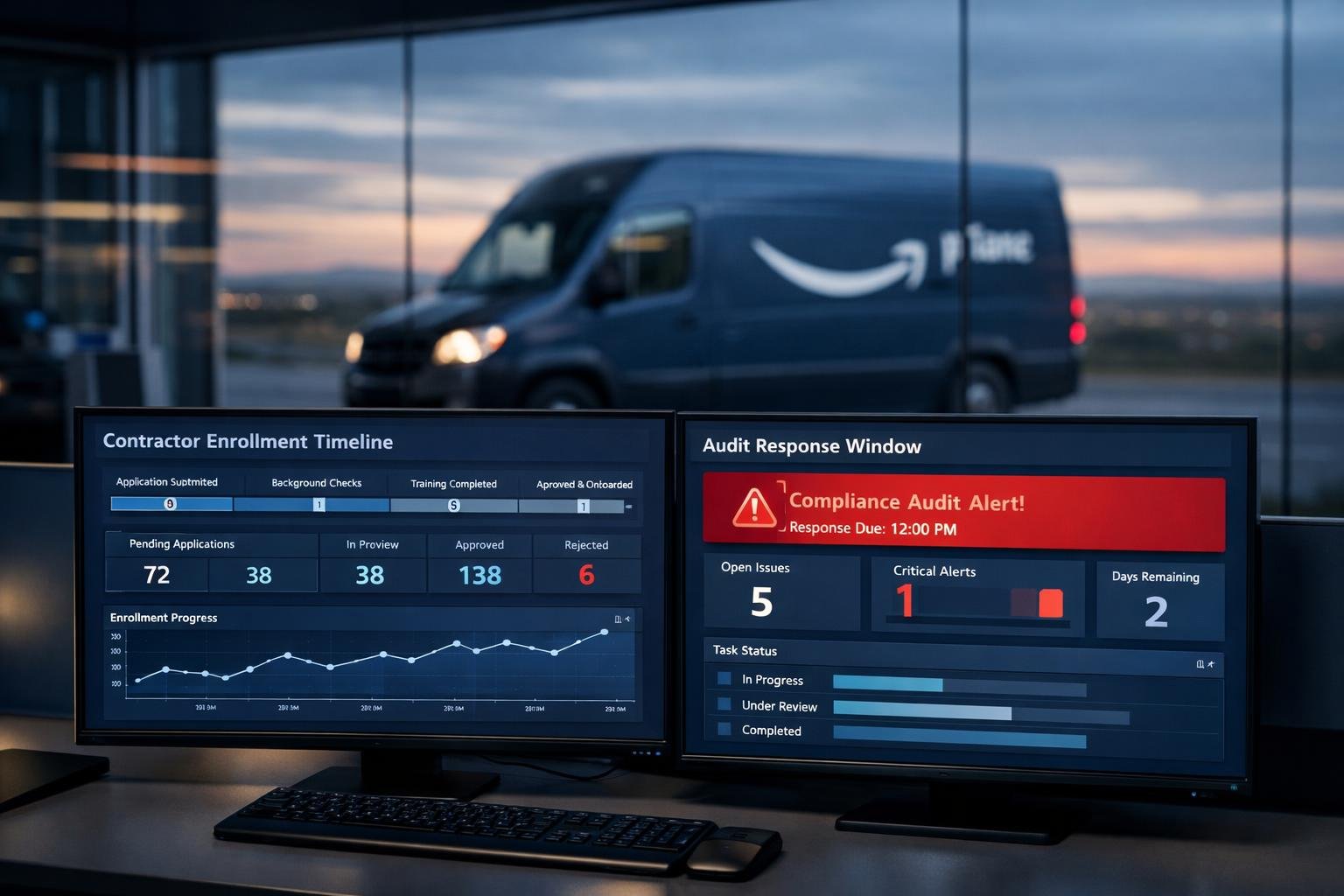
If your incumbent OAI carrier on a DSP account can’t ship a complete contractor enrollment record within 48 hours of a DOL letter landing, you’re already losing the audit. And in 2026, DSP audit defense is no longer a quiet conversation — the branded uniforms, fixed routes, and set schedules that Amazon mandates are now textbook misclassification indicators in front of every regional DOL investigator.
Lane A producers writing DSP business have been selling around this for years. The question is no longer whether your DSP client looks like an audit target — they do. The question is whether your current OAI placement actually defends them when the audit lands. Most don’t. They write the certificate, collect the premium, and ghost when the producer needs documentation in a 30-day window.
The Branded-Driver Tripwire DSP Owners Don’t See Coming
The DOL audit profile for a delivery service partner isn’t subtle. The same operational features Amazon mandates — branded uniforms, set delivery windows, fixed routes, supervised rosters, daily rescue support — are the exact behavioral controls that misclassification statute uses to flip an independent contractor classification on its back. The DSP owner sees efficiency. The auditor sees a W-2 employee in 1099 packaging.
Your DSP client cannot remove the uniform, the route, or the schedule. Amazon’s Service Provider Agreement requires them. So the defense doesn’t come from changing operations — it comes from documenting independence in every other dimension and producing a paper trail that survives subpoena. That paper trail is the asset. The carrier you placed the OAI policy with either builds it for you, or sticks you with a binder PDF and a phone number.
What the Audit Letter Actually Demands
When the DOL letter arrives, your DSP client has 30 days to respond with documentation. The producer becomes the documentation officer. The carrier becomes the bottleneck. Here is what you have to ship — and where most incumbent OAI placements collapse.
Contractor enrollment records with timestamps
Each driver’s enrollment into the OAI program needs to be timestamped, contractor-initiated, and digitally signed. The auditor is looking for behavioral evidence that the driver acted as an independent business — selecting their coverage, accepting their rate, signing their own enrollment. If your incumbent runs paper enrollment, those records do not exist in the form the auditor accepts. They become hearsay.
Coverage history across all 50 states
If your DSP client expanded into a second metro mid-year and the incumbent required a state-by-state endorsement, there is a coverage gap. The auditor will find it. A federal ERISA-preempted program runs all-states by default — no gap, no endorsement scramble, no producer holding the phone waiting on a carrier underwriter to write coverage that should have been live on day one.
Real-time bind and termination records
Independent contractor turnover at a DSP is high. The driver who got hurt in March may have onboarded in January and terminated in February. The audit demands proof of when coverage started, when it ended, and who initiated each action. Pay-as-you-go OAI billing produces that record by design. Monthly premium audits produce a footprint that looks like the carrier was guessing — which the DOL reads as evidence the contractor relationship wasn’t operationally independent.
Where Your Current OAI Placement Falls Down
Here is the uncomfortable scorecard most Lane A producers know but don’t say out loud.
4-day bind times leave gaps in the enrollment trail
When a DSP client onboards 12 drivers on a Monday, your incumbent takes until Thursday to bind. Those four days are gaps in the documented paper trail of contractor independence — gaps the auditor reads as the producer covering for a sloppy onboarding process. A program that binds in hours doesn’t leave those gaps. The enrollment record matches the W-9 record matches the route assignment record. Clean.
Monthly premium audits look like the carrier is guessing
Premium audit reconciliation is fine for property and GL. It is poison for an OAI placement designed to defend against misclassification. The auditor wants to see real-time correspondence between contractor activity and coverage activity. Pay-as-you-go billing produces that. Monthly true-ups don’t.
State-by-state endorsements create coverage gaps the auditor finds
If your DSP client runs into California, Texas, and Arizona and the incumbent endorses each state separately, you have multiple coverage start dates, multiple terms, and multiple opportunities for a driver to be active before coverage was effective. The DOL doesn’t care about the underwriting reason. They care about the gap. Federal ERISA preemption removes the gap because the program runs nationally on day one.
No co-branded enrollment = no producer fingerprint
This is the quiet one. If your enrollment portal shows the carrier’s logo, the contractor’s enrollment looks carrier-initiated. If the portal shows your agency’s logo on a co-branded white-label, the contractor’s enrollment looks agent-initiated and contractor-completed. Same coverage, different audit narrative. Co-branded sales sheets and enrollment portals change the optics for the auditor and the optics for the DSP owner.
What Real DSP Audit Defense Looks Like in 2026
A defensible OAI placement on a DSP account is not just coverage. It’s an evidence factory. Every driver enrollment generates a timestamped, contractor-signed record. Every bind and term hits a single registry that runs all-states by default. Every premium activity ties to a billing pass-through the contractor authorized — including the 3% credit card or ACH fee that under our model is legally passed to the insured and shows up as another behavioral marker of contractor financial responsibility.
That documentation, taken together, is what we call the compliance firewall — a documented paper trail of contractor independence that turns a DOL audit into a paperwork exercise instead of an existential event. The DSP owner can’t change their uniforms. They don’t have to. The defense is built somewhere else.
The Switch — How the Move From Your Incumbent Actually Works
Producers stall on switching their DSP OAI placement because they assume the move is painful. It isn’t. Here is what the actual transition looks like.
Appointment in days, not quarters. Carrier appointments through legacy OAI markets take 60–90 days. Producer appointment with us runs in days because there is no captive-carrier underwriting committee to navigate. The process is built for the velocity Lane A agents actually work at.
No book transfer pain. You don’t have to move your entire DSP book at once. Start with the next renewal, the next new logo, or the highest-risk audit candidate on the book. Parallel quoting is allowed — quote the same risk through the incumbent and through our program, deliver both to the client, let the client decide. Most producers find the client decides faster than the incumbent’s underwriter responds.
Co-branded materials ready on day one. The producer’s agency name and logo land on the sales sheets, enrollment portal, and contractor-facing collateral inside the first week. The audit defense story you tell your DSP client is your story, branded as yours, defended by us. That is the move.
If you write DSP business through an incumbent OAI carrier that doesn’t ship documentation, doesn’t run real-time billing, and doesn’t co-brand the producer’s fingerprint onto the enrollment record, the next audit on your book is going to expose the placement before it exposes the client. Lane A producers who have already switched aren’t quieter about it because they’re keeping a secret. They’re quieter about it because they’re winning the renewals the incumbents lose.