
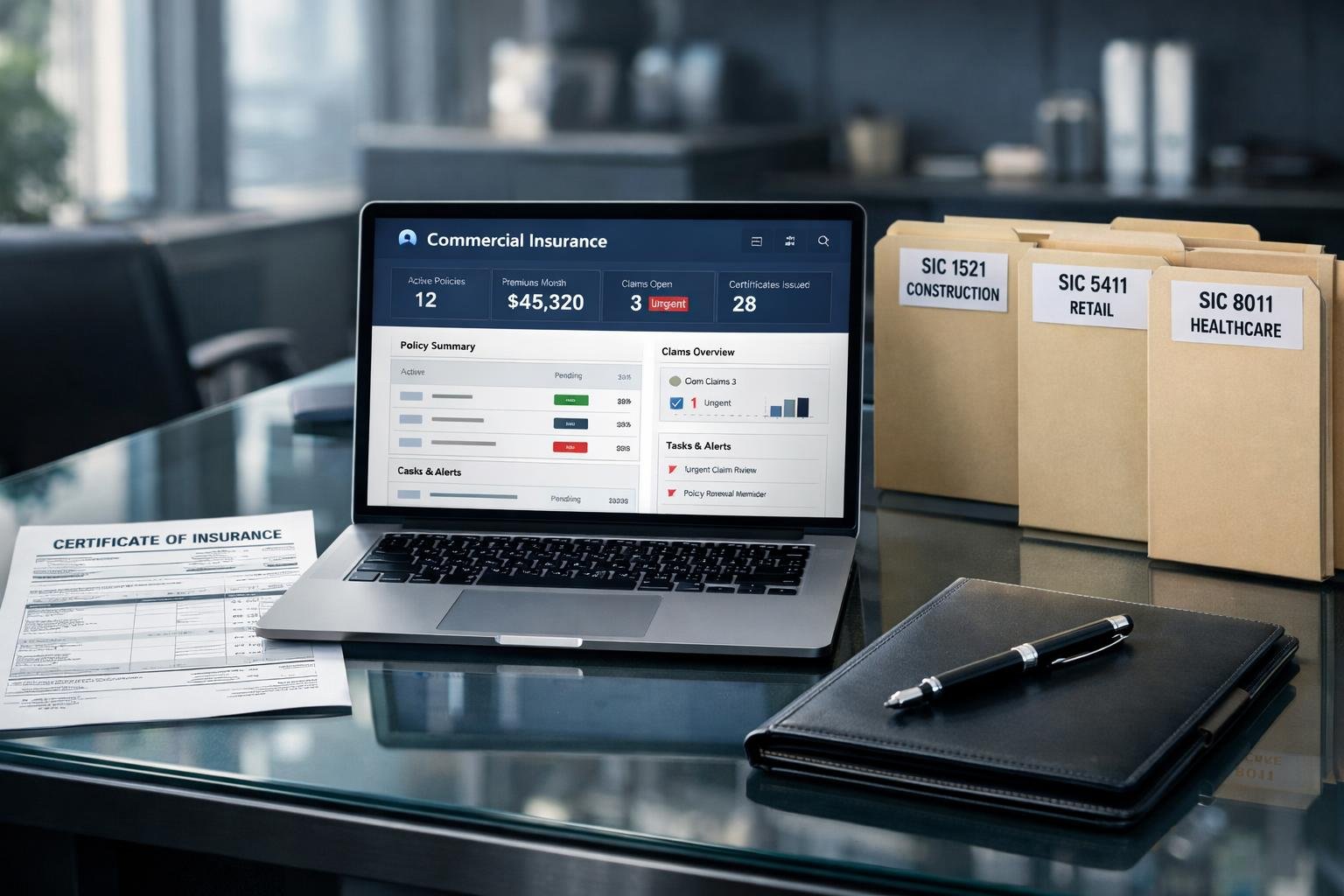
Your IT consulting client with the rotating engineer bench is the most obvious 1099 OAI cross-sell on your desk. The staffing firm next to it. The ad agency above it. None of them carry Occupational Accident coverage on their independent contractor spend. None of their current carriers will quote it. And every renewal you book without putting it on the table is a closing tool you hand to the next producer down the street.
This is the most underwritten conversation in commercial right now — and the math, the appointment workflow, and the account-stickiness story all line up in the producer’s favor.
The 1099 OAI Cross-Sell Sitting on Your Existing Book
You already have the relationships. You already have the certificates. You already wrote the GL, the E&O, the commercial auto, the cyber, the umbrella. The independent contractor exposure on those accounts is not new — it is the part of the file that has been quietly growing for three renewal cycles while nobody quoted it.
There are three SIC codes on every commercial agency’s book where the cross-sell math is so clean it should feel like running an audit on yourself.
Staffing Firms (SIC 7363)
The staffing firm books a $40K commercial package with you every year. Their W-2 internal staff sits on the workers’ comp. The 1,200 contract placements they ran last quarter sit on nothing. When a placement gets hurt on a client site, the staffing firm’s defense is that the placement was an independent contractor and the client is the assignee. The Department of Labor and the plaintiff’s bar look at it differently. The placement was a 1099, on a fixed schedule, under client supervision, paid a regular hourly rate. Workers’ Comp is for W-2 employees. The WORK Program is for the 1099 economy. They are legally distinct tools for legally distinct workforces — and the staffing firm has been carrying half the equation.
The cross-sell adds OAI to the 1099 spend at a real-time, pay-as-you-go billing rate that scales with actual contract hours. You add a $4K-$18K line to a $40K account depending on contract volume. You also bake in the documented paper trail of contractor independence that turns a lawsuit into a claim instead of a misclassification penalty.
IT Consultancies and Boutique Software Firms (SIC 7379)
The IT consultancy you wrote last year runs a bench of seven W-2 engineers and a rotating pool of fourteen 1099 senior architects. The 1099 architects bill at $180/hour, work eight to twelve weeks at a clip, and use the consultancy’s GitHub, Slack, and client-facing email. The exposure pattern is textbook 1099 OAI: project-based work, no employer of record on the contractor, real injury risk if the contractor is on-site at a client.
This is the cleanest cross-sell on a producer’s book. The premium scales with the contractor spend the consultancy already reports for tax purposes. The agency gets a sticky line of business on an account that is otherwise easy to shop. Your incumbent on the placement isn’t quoting it — they don’t have an OAI program built for the commercial generalist’s appetite.
Ad and Marketing Agencies (SIC 7311)
The marketing agency you wrote in February runs eight 1099 designers, freelance copywriters, and a video team. Most of the 1099 spend is short-cycle, but the renewal pattern is sustained. When a freelance videographer trips on a film set and tears a knee, the agency has no answer. There is no workers’ comp because there are no W-2s on that line. There is no general liability response to a contractor injury. There is no 1099 OAI in place because nobody quoted it.
This cross-sell is small in premium but huge in account stickiness. Once OAI is on the marketing agency’s file, the relationship is harder to unwind at renewal.
Why the Incumbent Agency Isn’t Already Quoting This
Two reasons.
The first is appointment. Most commercial generalists do not have an OAI carrier appointment that writes outside trucking. Their go-to OAI placement is built for owner-operators and motor carriers — and they have never been shown a program that writes staffing, IT, healthcare staffing, professional services, last-mile DSP, and last-mile install all in one appetite. We sit on the commercial side of the program, which is exactly where the cross-sell lives.
The second is workflow. Even the carriers that technically write non-trucking OAI run the placement on a manual, premium-audit, paper-based workflow that producers do not want to touch on an account smaller than $250K. Bind times stretch into days. Contractor enrollment is paper. Billing is monthly premium audit, not real-time pay-as-you-go. State-by-state endorsements are required. The producer abandons the cross-sell because the work is not worth the premium.
Both problems disappear when the producer has access to a 1099 OAI program built for digital enrollment, real-time billing, and federal ERISA preemption that ships the same product across all 50 states without state-by-state endorsements. That is the move.
What the Producer-Led 1099 OAI Conversation Sounds Like
This is not a pitch for the contractor. The contractor does not sign anything different than they sign today. This is a pitch for the hiring entity — your staffing firm, your IT consultancy, your ad agency — that adds a documented compliance firewall to the account.
The conversation is three sentences long.
“Your 1099 contractor spend has been growing on this account for the last three renewals and nobody has quoted you on it. There is a program that adds Occupational Accident coverage to that spend at real-time pay-as-you-go billing — your premium scales with actual contract hours, not a year-end audit. It also generates the contractor-independence documentation that protects the account if a Department of Labor question ever comes up.”
That is the opener. The renewal conversation does not change. The line item is small. The account stickiness, the defensibility, and the producer’s positioning all jump at once.
The Cross-Sell Math on the Producer’s Book
On a $40K-$80K commercial account in staffing, IT, healthcare staffing, or last-mile, 1099 OAI is a $4K-$20K premium add. That is a 10-25% account expansion with no replacement of any existing line. The certificate is already in your file. The hiring entity is already the named insured. The producer’s pre-existing book of business does the heavy lifting — the cross-sell is the close, not the prospect.
For the new-logo conversation, the math gets sharper. A commercial generalist who walks into a 30-employee staffing firm or 12-engineer IT consultancy with the 1099 OAI cross-sell in hand is the only producer in the conversation who has the program. The incumbent agency loses on capability, not on price.
Run an exposure scan on the book before the next renewal cycle. The scan surfaces the SIC codes already on the file where the cross-sell math is cleanest and shows the contractor-independence gaps that the current placements are not addressing.
The Appointment and the Switching Mechanics
Producer-level appointment turns in days, not quarters. The carrier-side paperwork is minimal because the program is administered through a digital underwriting workflow, not a state-by-state surplus lines process. There is no book transfer pain because the cross-sell adds a new line — it does not displace existing commercial coverage. Producers who are already appointed on the GL, the workers’ comp, and the commercial auto leave those placements untouched and add 1099 OAI alongside them.
For producers who want to run parallel quotes on a renewal — current OAI placement versus the WORK Program — that is fully supported. The carrier is comfortable with a parallel quote so the producer can walk the client through the side-by-side: bind speed, billing cadence, all-states availability, contractor enrollment workflow, claims response time, and the co-branded materials that ship with the program.
Producer appointment is a single application. Co-branded materials for the renewal conversation are generated the same day the appointment confirms.
The Bottom Line for Commercial Producers
The 1099 OAI cross-sell is the most underwritten line on the commercial book right now. It scales with the contractor spend the account already reports. It adds defensibility, account stickiness, and a closing tool the incumbent agency cannot match. It runs at a 10-25% account expansion on existing renewals and a meaningful win-rate lift on new logos in staffing, IT, healthcare staffing, professional services, and last-mile.
The producers who put this on the table this quarter are the ones taking the accounts in 2027.