
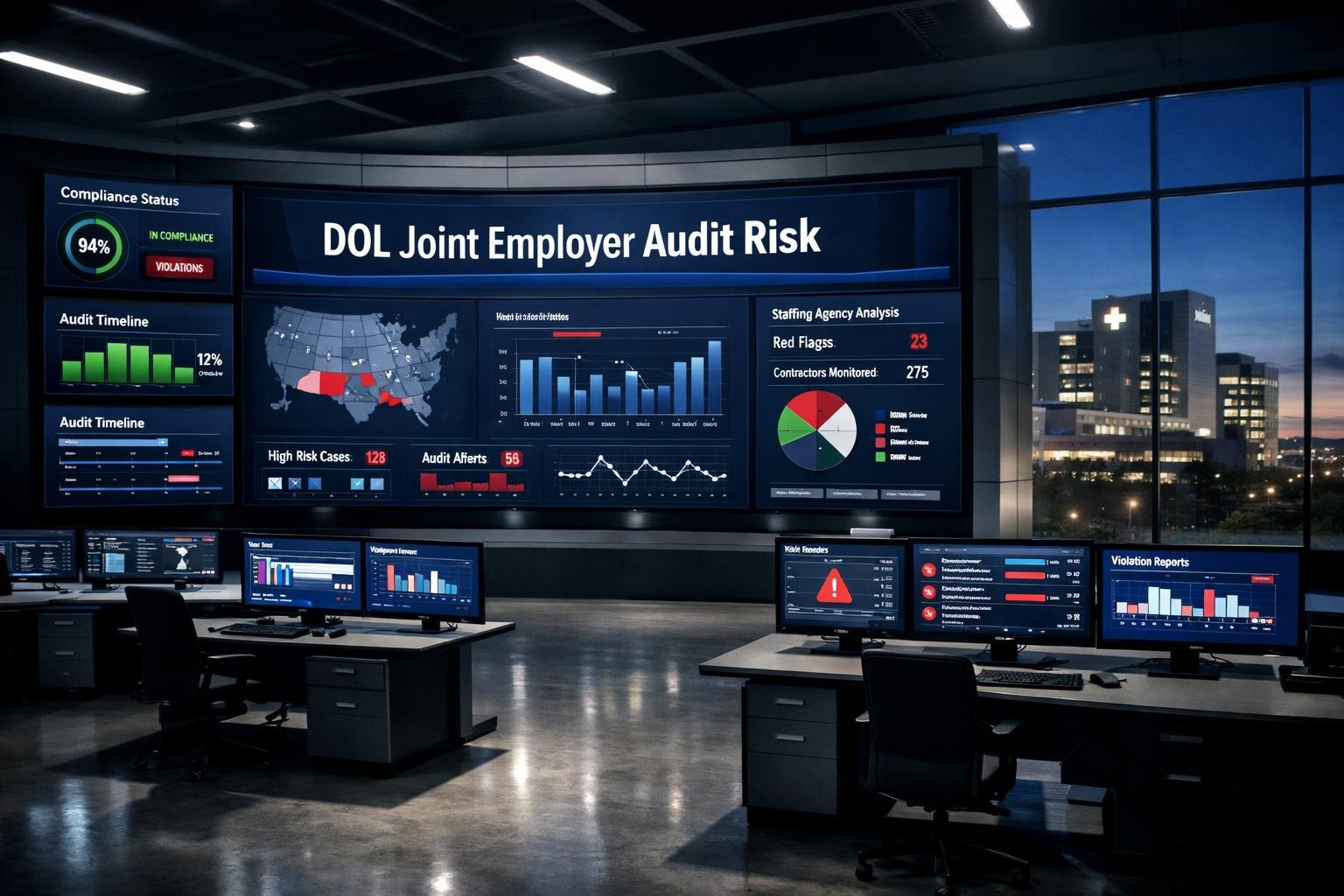
Healthcare staffing 1099 compliance has become the single most expensive blind spot in the per diem and travel nurse industry. The Department of Labor’s 2026 enforcement priorities target a specific failure mode: agencies that classify clinicians as independent contractors while their hospital clients exert hands-on control over schedules, protocols, and supervision. When the audit lands, both the staffing agency and the healthcare facility get named — and the joint employer doctrine means joint liability for unpaid taxes, retroactive benefits, and statutory penalties.
This is not a theoretical exposure. The Wage and Hour Division opened more than 1,400 joint employer investigations into healthcare staffing arrangements in the trailing twelve months. The agencies that survived had one thing in common: bulletproof 1099 compliance architecture. The agencies that did not are either out of business or operating under consent decrees.
What the Joint Employer Doctrine Actually Means for Staffing Agencies
The joint employer concept is not new, but the 2026 DOL Independent Contractor Rule sharpened the teeth considerably. Under the current Economic Reality Test, regulators evaluate six factors when deciding whether a per diem clinician is truly independent: opportunity for profit or loss, investments by both parties, degree of permanence, nature of control, integration into the business, and skill or initiative. If the staffing agency and the hospital each exert meaningful control over the worker, both can be deemed joint employers — regardless of which entity cuts the check.
In a typical 1099 misclassification audit, the DOL traces the control chain. Who sets the shift? Who supervises clinical decisions? Who enforces dress code, charting standards, and break rules? Who has the authority to remove the clinician from the assignment? When the answer to most of these questions is “the hospital,” the staffing agency cannot hide behind contract language calling the clinician an independent contractor. The economic reality controls the legal classification, and the contractual label is largely irrelevant once an investigator opens the file.
Why Healthcare Is the DOL’s Top Audit Vertical
Three structural features make healthcare staffing the highest-value target on the DOL’s docket. First, the dollar amounts are large — hospital networks pay agencies hundreds of millions annually, and back-tax recovery scales accordingly. Second, the worker pool is concentrated in regulated professions where state licensure boards already maintain detailed records, making proof of misclassification trivial to assemble. Third, healthcare facilities are politically sympathetic plaintiffs when class action lawyers come knocking, which means civil litigation tends to follow regulatory action like clockwork.
A single joint employer finding can unwind years of margin. The penalties stack: unpaid federal payroll taxes with interest, state unemployment insurance contributions, workers’ compensation premiums calculated retroactively against the staffing agency, and liquidated damages under the Fair Labor Standards Act. Then come the civil claims from the clinicians themselves — overtime, expense reimbursement, and benefit equivalency. The total exposure on a mid-sized agency frequently exceeds three years of net income.
The Three Audit Triggers Every Healthcare Staffing Agency Should Know
The DOL does not audit randomly. Three triggers account for nearly every healthcare staffing investigation opened in the last calendar year, and any serious healthcare staffing 1099 compliance program must address all three.
Trigger one: a clinician files an SS-8. The IRS Form SS-8 lets a worker formally request a classification determination. Once filed, it routes to the DOL automatically and opens a parallel investigation. Per diem nurses and travel allied health professionals file SS-8s when they realize they have been denied unemployment, benefits, or injury coverage they expected — most often after a workplace incident or contract termination.
Trigger two: a state Department of Labor referral. California, New York, New Jersey, Illinois, and Massachusetts now share audit findings with federal regulators automatically. A state-level wage claim against a hospital triggers a federal review of every staffing agency that placed workers there. This is the multi-state cascade that has consumed several major staffing platforms in the last eighteen months.
Trigger three: an OSHA injury report with no coverage in force. When a per diem clinician is injured on a hospital shift and no injury policy covers the loss, OSHA flags the file. The flag automatically generates a DOL inquiry into the worker’s classification status. This is the trigger most operators do not see coming, and it is the trigger most commonly fatal to the agency under investigation.
The OAI Coverage Gap That Triggers Audits
The injury-trigger pathway is where the 1099 Protect framework becomes structurally essential. When a 1099 clinician is hurt on shift, they have no statutory injury coverage from the hospital or staffing agency — by design, because that protection is reserved for W-2 employees. The 1099 independent contractor is supposed to carry their own Occupational Accident Insurance. OAI is the legally distinct product engineered for this exact purpose: it covers medical costs, disability income, and accidental death benefits for independent contractors operating outside the W-2 framework.
When an injured 1099 clinician has no Occupational Accident Insurance in force, the medical bills get paid out of pocket, the clinician misses income, and the only available legal remedy is a misclassification lawsuit against both the staffing agency and the hospital. Verifiable OAI coverage at the moment of injury breaks the chain. It also signals to auditors that the agency runs a serious compliance operation — which materially changes how investigations proceed and how aggressively regulators pursue penalties.
Building the Healthcare Staffing 1099 Compliance Firewall
A defensible healthcare staffing 1099 compliance posture rests on four operational pillars. None of them are optional in 2026.
The first pillar is written independent contractor agreements that mirror economic reality. Boilerplate language calling the clinician an independent contractor is worthless if the agency exerts day-to-day supervision. Agreements must explicitly memorialize the clinician’s freedom to accept or reject shifts, set their own schedule within hospital constraints, work for competing agencies, and operate without exclusive territorial restrictions. Any language inconsistent with that economic reality becomes evidence against the agency in an audit.
The second pillar is verified Occupational Accident Insurance for every active clinician. The agency must hold proof of coverage at the moment of placement and at every renewal cycle. Coverage gaps create joint employer exposure faster than any other operational failure. A single uncovered injury can detonate the entire book.
The third pillar is a documented profit-and-loss arrangement showing the clinician bears actual business risk. This includes the clinician’s ability to negotiate rates, invest in their own equipment and continuing education, and incur losses independent of the agency. Without this evidence, the Economic Reality Test almost always tips toward employee status.
The fourth pillar is hospital client education and contractual indemnity. The staffing agency must require the facility to acknowledge in writing that the clinician is an independent contractor and that the facility will not direct work in ways inconsistent with that classification. This does not eliminate joint employer risk — economic reality still controls — but it materially shifts indemnity in downstream litigation and gives the agency leverage in settlement discussions.
What the WORK Program Delivers for Healthcare Staffing 1099 Compliance
The 1099 Protect WORK Program was engineered around exactly this risk profile. It provides verified Occupational Accident Insurance with pay-as-you-go billing tied to shift volume, real-time certificate generation for hospital client compliance files, and audit-ready documentation that satisfies both DOL economic reality testing and joint employer indemnity requirements. Agencies that deploy the WORK Program close the OAI coverage gap and harden their classification posture in the same operational motion.
For insurance agents working with healthcare staffing accounts, the upside is structural. The agency client transitions from chronic audit anxiety to defensible compliance. The renewal conversation shifts from price negotiation to coverage architecture. The agent becomes the indispensable strategic resource rather than a commodity policy vendor — and the retention rate on accounts placed inside the WORK Program is materially higher than on traditional general liability and umbrella structures.
The Next 90 Days for Healthcare Staffing Operators
DOL enforcement budgets for fiscal 2026 are weighted toward healthcare staffing specifically. The smart operators are auditing their own books now — identifying which clinicians lack verified Occupational Accident Insurance, which hospital contracts contain dangerous control language, and which agreements fail the Economic Reality Test on inspection. The operators who wait until they receive a DOL letter are already losing the case.
If you run a healthcare staffing agency, place per diem clinicians, or write insurance for either, the joint employer audit risk is no longer a tail event. It is the baseline operating environment. The agencies that build a real healthcare staffing 1099 compliance firewall this quarter will outlast the ones that do not.
Connect with the 1099 Protect WORK Program team to evaluate your healthcare staffing book and close the OAI coverage gap before your next renewal cycle.