
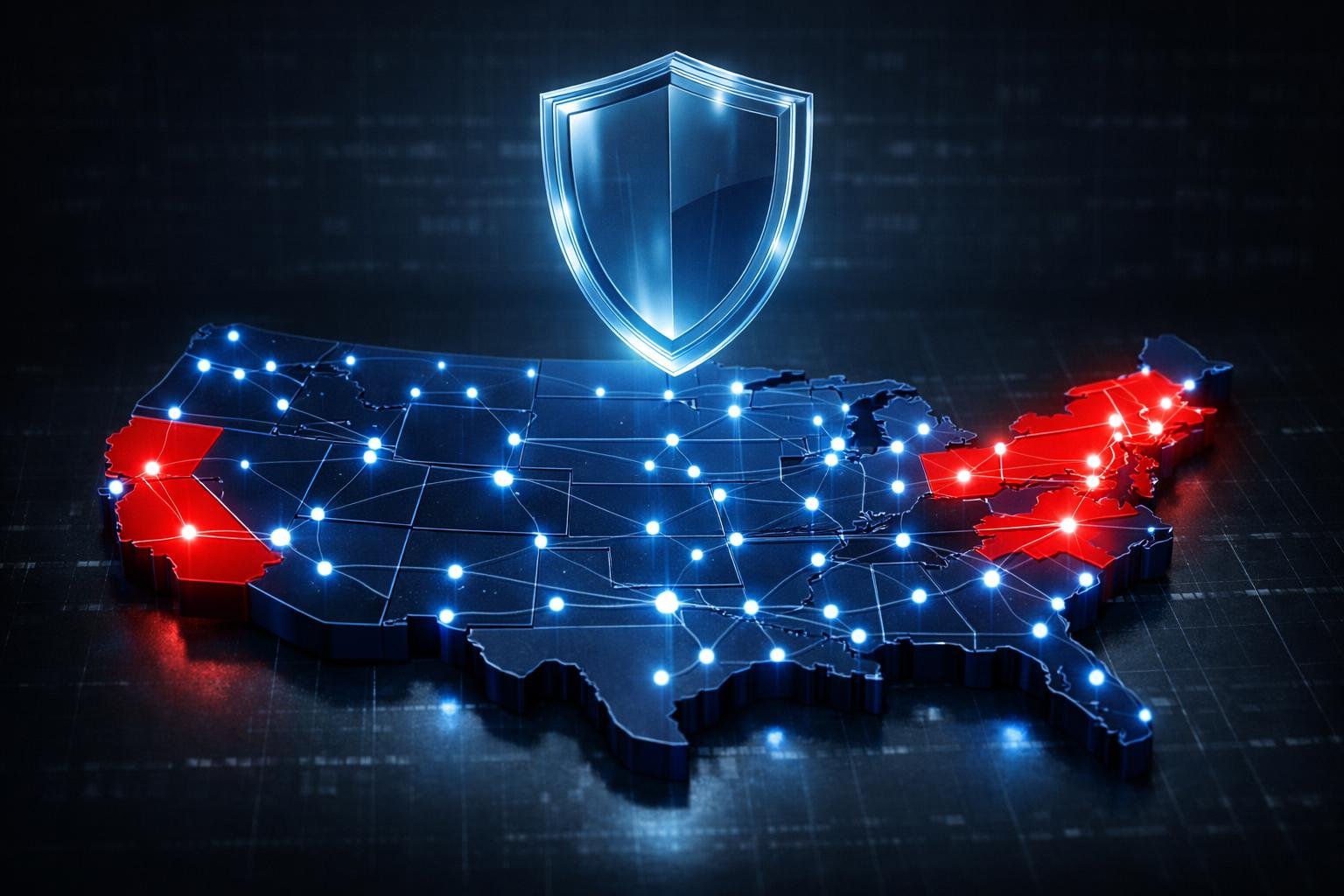
Most hiring entities still believe their biggest 1099 misclassification threat is the federal Department of Labor. That assumption is now dangerously outdated. In 2026, state 1099 audits are outpacing federal enforcement in both volume and severity, and California’s AB5 statute has become the template that legislatures across the country are quietly copying. If your business uses independent contractors in more than one state, you no longer face one regulator. You face fifty.
The shift is structural. State labor agencies have realized that misclassification audits generate revenue: unpaid unemployment insurance contributions, state income tax withholding, workers’ compensation premium penalties, and civil fines. Where federal enforcement is bound by political cycles and budget constraints, state attorneys general and labor commissioners operate continuously and aggressively. The result is a patchwork of state 1099 audits that can hit your business from multiple jurisdictions simultaneously, often triggered by a single unemployment claim or a tip from a former contractor.
The California AB5 Blueprint: How One Law Reshaped State 1099 Audits Nationwide
California’s Assembly Bill 5, originally enacted in 2019 and expanded through subsequent rulemaking, codified the ABC test as the default standard for classifying workers in the state. Under the ABC test, a worker is presumed to be an employee unless the hiring entity can prove all three prongs: (A) the worker is free from control and direction, (B) the work is outside the usual course of the hiring entity’s business, and (C) the worker is customarily engaged in an independently established trade.
The B prong is the killer. A logistics company that uses 1099 drivers, a clinic that uses 1099 nurses, or an IT firm that uses 1099 developers will struggle to argue that the work is outside its usual course of business. AB5 effectively reclassified entire industries overnight, and California’s Employment Development Department now uses the statute as a hammer in state 1099 audits that have collected hundreds of millions in back taxes and penalties.
The bigger problem is that AB5 has become a model. Legislatures in other states have either adopted the ABC test outright or borrowed its prongs piecemeal. The federal independent contractor rule, while different in structure, has also tilted enforcement in a worker-friendly direction. The cumulative effect is that hiring entities with multi-state operations now face a moving target where the rules change at the state line.
States Adopting AB5-Style Frameworks
The AB5 contagion has spread along predictable lines, with progressive states moving first and others following through agency rulemaking rather than headline legislation.
Northeast Corridor: New Jersey, Massachusetts, Connecticut
New Jersey has used the ABC test for unemployment determinations for decades, but the state’s Department of Labor and Workforce Development has dramatically increased enforcement, conducting cross-agency state 1099 audits with the Division of Taxation and the Office of the Attorney General. Massachusetts applies a similarly strict three-prong test under M.G.L. c. 149, with the B prong interpreted aggressively by state courts. Connecticut has followed suit, and New York has signaled through enforcement actions that it intends to move in the same direction.
Pacific Northwest and Mountain West
Washington and Oregon have adopted ABC-style standards for unemployment and wage-hour purposes, and Colorado has expanded its definition of employee for state tax purposes. Even Utah and Idaho, traditionally business-friendly, have tightened scrutiny on construction and trucking 1099 arrangements following federal enforcement priorities.
Midwest and South
Illinois and Michigan are the most aggressive Midwestern states, with Illinois conducting joint audits between the Department of Employment Security and the Department of Revenue. Even Southern states like Virginia and North Carolina have increased state 1099 audits in industries with high contractor density, particularly trucking, healthcare staffing, and last-mile delivery.
Why State 1099 Audits Hit Harder Than Federal
Hiring entities that have weathered a federal DOL inquiry often underestimate state-level risk. The reality is that state agencies have structural advantages that make their audits more damaging. State labor departments have direct access to unemployment insurance filings, meaning a single denied claim by a former 1099 contractor can trigger an automatic look-back across every worker the entity has classified as a contractor. Federal audits typically begin with a complaint or sector sweep; state audits often begin with a database query.
State 1099 audits also carry penalty multipliers that compound quickly. Where federal misclassification penalties are bounded by statute, many states stack unpaid unemployment contributions, interest, civil fines, and workers’ compensation premium retroactive assessments. In jurisdictions like California and New York, hiring entities have paid more in state penalties than in federal back taxes for the same misclassification finding.
The third structural disadvantage is jurisdictional overlap. A trucking company with drivers running freight in five states can face concurrent state 1099 audits in every jurisdiction where a driver picked up or delivered a load. Each state applies its own classification test, and a contractor who passes muster in Texas may be reclassified as an employee in California, triggering a cascade of liabilities the hiring entity never anticipated.
Building a Multi-State Compliance Firewall
The defense against state 1099 audits is structural, not reactive. Hiring entities that have survived multi-state enforcement share four common practices. First, they document the independence of every contractor with airtight written agreements, separate business entities, and evidence of independent client work. Second, they treat the most restrictive state’s classification test as the floor for their entire operation rather than running multiple compliance regimes. Third, they maintain real-time records of where contractors perform work, because nexus drives jurisdiction. Fourth, they layer insurance products that protect both the contractor and the hiring entity from the financial consequences of an injury or claim that could otherwise trigger a state inquiry.
This is where occupational accident insurance enters the compliance firewall. When a 1099 contractor is injured, the hiring entity’s first exposure is medical and disability cost, but the second exposure is a workers’ compensation board referral that often escalates into a state 1099 audit. By providing OAI coverage, the hiring entity removes the financial pressure that causes injured contractors to seek workers’ compensation benefits, which in turn removes the most common audit trigger. The WORK Program from 1099 Protect is purpose-built for this scenario, with pay-as-you-go billing that scales with active contractor count.
The Documentation Stack That Survives a State Audit
Insurance alone is not enough. A defensible 1099 arrangement requires a documentation stack that an auditor can review in under thirty minutes and walk away unconvinced of a misclassification claim. The stack includes a contractor agreement that reflects actual control, evidence of the contractor’s separate business operations, 1099-NEC filings with corresponding state reports, proof of OAI coverage, and a written record of how the contractor’s work product was delivered and paid. Hiring entities that maintain this stack survive state 1099 audits with minimal disruption. Those that do not, regardless of how the work was actually performed, often lose on procedural grounds alone.
The trend is unambiguous. State 1099 audits will continue to accelerate through 2026 and beyond, and hiring entities that operate across multiple jurisdictions face the highest risk. The question is not whether your state will adopt AB5-style enforcement but when, and whether your contractor program will be ready. Request a coverage quote to begin building the compliance firewall your business needs, or learn more about how 1099 Protect partners with insurance agents and hiring entities to deliver audit-ready protection in hours, not days.