
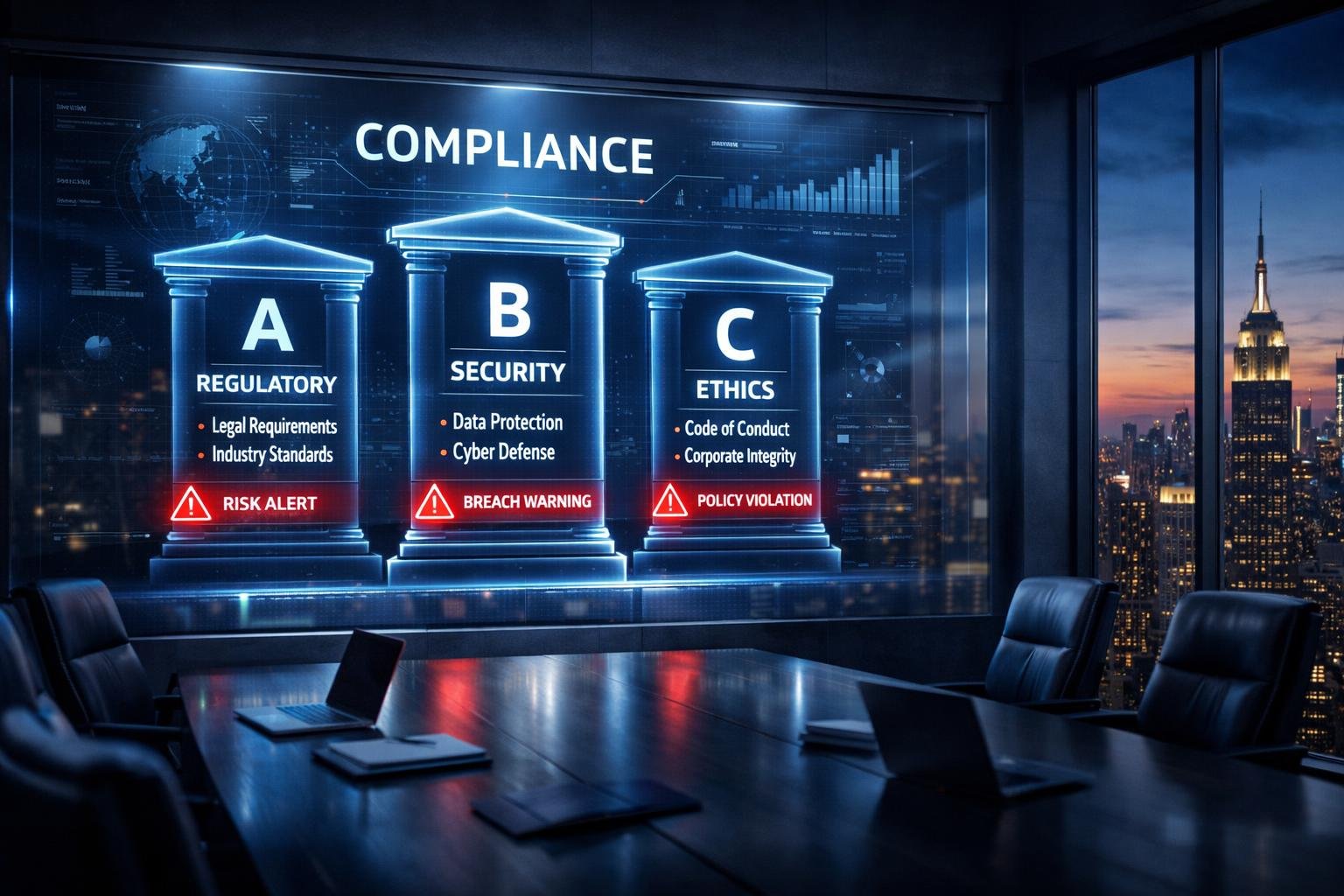
The ABC test 1099 classification framework is quietly becoming the single most dangerous audit tripwire for American businesses that rely on independent contractors. If your company uses 1099 workers—whether they are owner-operators, traveling nurses, IT consultants, or last-mile drivers—there is a very real chance you are already failing at least one prong of the ABC test and do not know it. Once the Department of Labor (DOL) or a state agency opens an audit, ignorance is not a defense. It is an accelerant.
This deep-dive unpacks exactly how the ABC test works, how DOL investigators apply it in the field, which prong most businesses fail, and what a modern Compliance Firewall looks like. If you are the owner, CFO, or operations lead of a business that touches independent contractors, treat this as an executive briefing, not a blog post.
What the ABC Test 1099 Classification Framework Actually Is
The ABC test is a three-prong legal standard used to determine whether a worker is a bona fide independent contractor or, in reality, a misclassified employee. Unlike the older, looser “economic realities” and “common law” tests, the ABC test is presumption-flipped: the worker is assumed to be an employee unless the hiring entity can prove all three prongs. Miss one prong, and the worker is reclassified as a W-2 employee by operation of law.
The three prongs are:
- Prong A — Control: The worker is free from the control and direction of the hiring entity in connection with the performance of the work, both under contract and in fact.
- Prong B — Outside the usual course of business: The worker performs work that is outside the usual course of the hiring entity’s business.
- Prong C — Independently established trade: The worker is customarily engaged in an independently established trade, occupation, or business of the same nature as the work performed.
States such as California (AB5), New Jersey, Massachusetts, Connecticut, and Illinois have adopted the ABC test outright for wage-and-hour and unemployment insurance purposes. The federal DOL uses a broader economic realities test, but in practice, investigators borrow heavily from ABC logic—especially on Prongs B and C—when building misclassification cases under the Fair Labor Standards Act (FLSA).
Prong A: Why “Control” Is More Than a Contract Clause
Most business owners assume they pass Prong A because their independent contractor agreement contains the magic words “contractor shall determine the means and manner of the work.” That clause is nearly worthless in an audit. DOL investigators look at behavioral reality, not contract language.
What investigators look for
Auditors will pull emails, Slack messages, training manuals, dispatch logs, and scheduling software to reconstruct how the work actually happened. Red flags include mandatory shift start times, dress codes, required attendance at company meetings, performance improvement plans, and any language that reads like supervision instead of scope management.
If your operations manager is sending a daily route sheet, pinging contractors when they deviate from the schedule, or running performance reviews, you are functionally controlling the work. Prong A fails. Full stop.
The fix
Rewrite the engagement around outcomes, not activities. Define deliverables, deadlines, and quality standards—then stop managing the how. Replace daily supervision with scope-based project orders. Train operations leaders on the difference between scope enforcement (allowed) and behavioral control (disqualifying).
Prong B: The Silent Killer of 1099 Programs
Prong B is where the majority of 1099 programs collapse—and it is rarely understood until the audit notice arrives. The prong asks whether the contractor performs work outside the usual course of the hiring entity’s business. In plain English: if the contractor is doing the thing you sell, they are almost certainly an employee.
Consider a logistics company whose core service is last-mile delivery. If that company engages “1099 drivers” to perform last-mile delivery, Prong B is mathematically impossible to satisfy. The driver is doing the usual course of business. No contract language, no paperwork, no insurance policy can patch this gap. The only cure is a structural redesign of the relationship—often through a qualified subcontracting entity or a legitimate brokered model.
The same logic crushes trucking motor carriers using owner-operators without proper leasing arrangements, healthcare staffing firms placing nurses directly into client facilities under their own brand, and IT consultancies billing contractor hours under the firm’s master services agreement. This is the prong that blew up the gig economy debate in California and triggered AB5.
Prong C: Proving the Contractor Is a Real Business
Prong C requires that the worker be customarily engaged in an independently established trade. Translation: they need to look, act, and operate like a real business—not a disguised employee with an EIN.
Auditors evaluate whether the contractor has their own clients, their own marketing, their own tools, their own insurance, and their own business risk. A contractor who works exclusively for one hiring entity, uses company equipment, and has no other clients will fail Prong C every single time. This is why serious 1099 programs insist that contractors carry their own Occupational Accident Insurance (OAI), general liability, and—where applicable—commercial auto coverage. Independent insurance is one of the cleanest, most defensible indicators of an independently established trade.
How DOL Audits Actually Unfold
Misclassification audits rarely start with the DOL knocking on the door. They usually start with a single disgruntled worker filing an unemployment claim, a workers’ compensation claim, or a wage complaint. State agencies share data with federal agencies. One claim triggers a portfolio-wide review.
Once open, the investigator will request payroll records, 1099 filings, contractor agreements, policy manuals, and communications. They will interview current and former workers. They will apply the ABC test (or the economic realities test federally) to every worker in the sample. If the sample fails, the finding is extrapolated to the entire contractor population. Back wages, overtime, liquidated damages, employer-side payroll taxes, unemployment contributions, and civil penalties stack fast. Six- and seven-figure assessments are routine. And personal liability can attach to owners and officers under the FLSA.
Building a Compliance Firewall Before the Audit
The businesses that survive misclassification audits are the ones that built a Compliance Firewall before a claim was ever filed. A real firewall has three layers:
- Structural: The business relationship passes Prongs A, B, and C by design, not by accident. Scope-based contracts, independent trade evidence, and no behavioral control.
- Documentary: Every contractor file contains proof of independent business—certificate of insurance, business license, marketing materials, evidence of other clients, and a signed statement of independent contractor status.
- Insurance: Every contractor carries independently held Occupational Accident Insurance. OAI covers the contractor for work-related injury, protects your company from tort exposure, and creates a durable paper trail that auditors read as Prong C evidence.
This is the exact architecture the team at 1099 Protect builds for hiring entities across trucking, healthcare, IT, and last-mile logistics. The WORK Program wraps OAI, compliance documentation, and audit-ready reporting into a single subscription so that your 1099 program is defensible on day one—not on audit day. For a live exposure check, the Exposure Identifier tool flags which of your contractor categories are most likely to fail the ABC test under current DOL enforcement trends.
The Executive Takeaway
The ABC test 1099 classification standard is not a theoretical legal framework. It is the operating playbook that federal and state investigators use to reclassify your contractors, trigger back-wage assessments, and attach personal liability to owners. The businesses that wait until an audit arrives to understand Prong B are the businesses that do not survive it.
If you use 1099 labor in any form—owner-operators, traveling nurses, subcontracted IT talent, DSP drivers—your next highest-leverage move is a structural audit of your own contractor program against all three prongs, followed by the installation of an OAI-backed Compliance Firewall. The cost of prevention is a rounding error compared to the cost of reclassification.
Ready to pressure-test your 1099 program against the ABC test? Book a Compliance Firewall review with 1099 Protect today and get a prong-by-prong exposure report before the DOL writes one for you.