
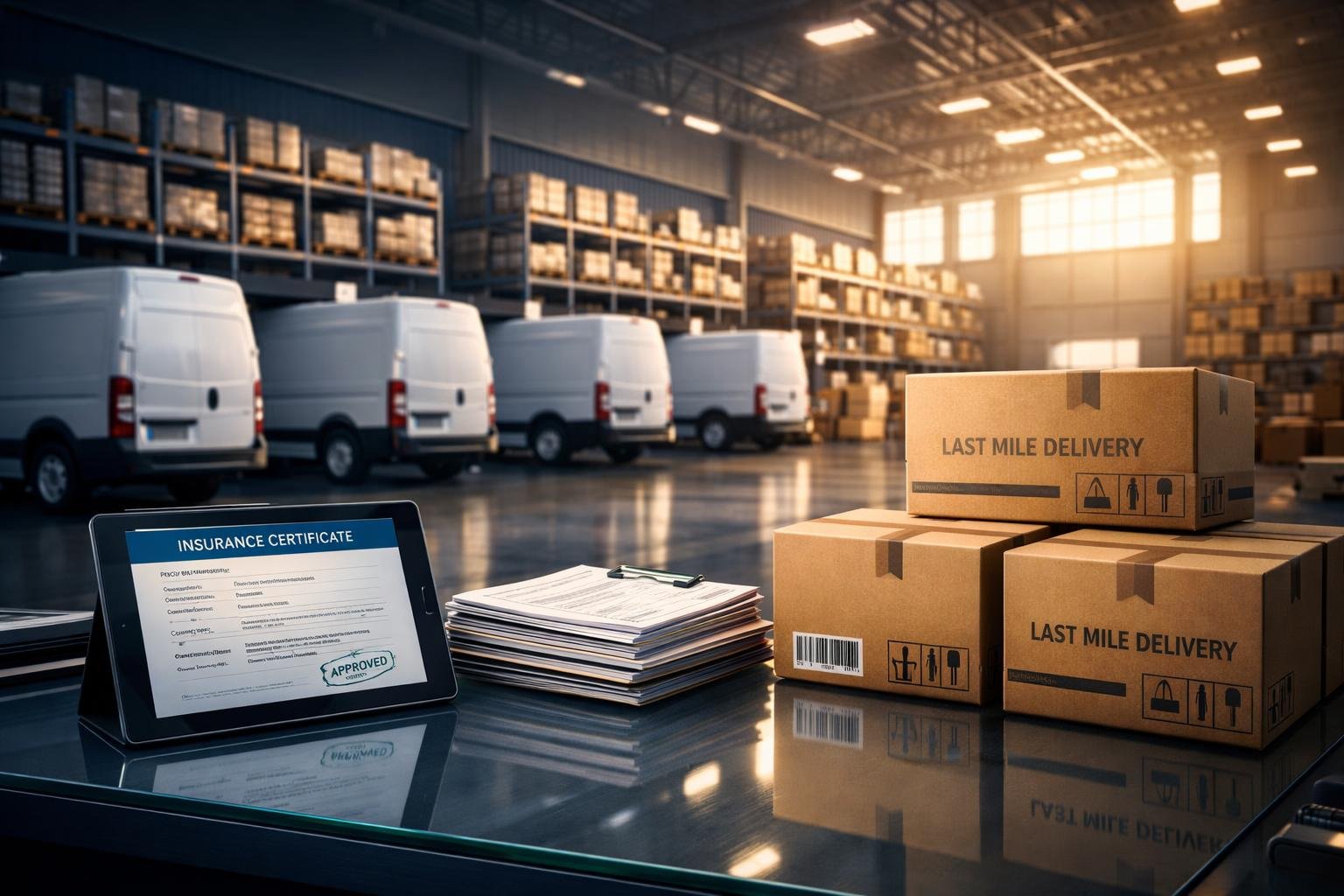
Wayfair and Home Depot have quietly moved from recommended to required on a specific line item: last mile contractor OAI coverage. If you run a delivery service partner, dispatch a fleet of 1099 independent contractors, or sell insurance to the companies that do, this shift is no longer a future-tense compliance debate. It is a hard-stop procurement condition that determines whether your drivers get assigned routes this quarter or sit idle in the yard.
Big-box retailers are now demanding proof of last mile contractor OAI coverage before a driver touches a pallet. This article breaks down what that coverage actually looks like, why it is legally distinct from Workers’ Compensation, and how independent insurance agents should position the product to delivery company owners who are suddenly scrambling to meet platform requirements.
Why Wayfair and Home Depot Tightened Last Mile Delivery Requirements
The furniture and home improvement verticals have a unique exposure profile. Heavy items, residential delivery environments, two-person lifts, and tight delivery windows create the perfect storm for on-the-job injuries. When a 1099 driver strains a back while carrying a sectional up a flight of stairs, the hiring entity, not the retailer, is the first target for a claim.
Historically, retailers kept their hands off the contracting relationship. That is changing. Wayfair’s CastleGate Delivery Network and Home Depot’s express last mile program now demand documented evidence that every last mile contractor carrying their freight has active occupational accident coverage at the driver level. No certificate, no route.
What Changed in Platform Vendor Agreements
Updated vendor onboarding packets now require:
- A named-driver schedule listing every 1099 contractor dispatched on routes
- Proof of minimum OAI benefit levels, typically $500,000 accidental death and $1,000 per week disability
- A 30-day cancellation notice endorsement naming the retailer as additional interest
- Evidence that coverage is pay-as-you-go and scales with active headcount
Legacy workers’ comp ghost policies do not satisfy these requirements. Neither does a general liability policy with a hired and non-owned auto endorsement. The retailers are specifically asking for last mile contractor OAI because the exposure is to the driver as a human, not the truck as a vehicle.
Last Mile Contractor OAI Is Not Workers’ Compensation
This distinction is the single most important concept for agents to internalize before walking into a DSP owner’s office. W-2 employees receive Workers’ Compensation. 1099 independent contractors receive Occupational Accident Insurance. These are legally distinct products governed by different statutes, different regulators, and different claim procedures.
A delivery company that puts its 1099 drivers on a workers’ comp policy has, by the act of providing that policy, created a strong evidentiary argument that those drivers are actually employees. The Department of Labor, under the 2024 independent contractor rule and subsequent enforcement guidance, treats benefit provision as one of several economic realities factors weighing toward employee classification.
Last mile contractor OAI sidesteps the classification trap because it is designed from the ground up as a contractor product. It does not create an employment nexus. It does not trigger payroll tax recharacterization. It protects the driver without collapsing the 1099 structure that makes the delivery business model viable in the first place.
The Coverage Mechanics of Last Mile Contractor OAI
A properly structured last mile contractor OAI policy includes:
- Accidental death and dismemberment benefits
- Temporary and permanent total disability income replacement
- Accident medical expense reimbursement
- A medical maximum that meets platform minimums, typically $500,000
Premium is computed on a per-driver, per-week basis, which aligns with how delivery contracting actually works. A DSP that flexes from 12 drivers in September to 40 drivers in December should not be paying annualized premium on a peak headcount that is only accurate six weeks of the year.
The DOL Misclassification Tripwire for Delivery Service Partners
Here is where the stakes escalate. Wayfair and Home Depot are not just protecting themselves from injury claims. They are insulating themselves from joint-employer liability. When a retailer mandates specific contractor coverage, they are simultaneously establishing in the paper trail that the drivers are contractors of the DSP, not the retailer.
A DSP owner who fails to produce last mile contractor OAI certificates is now flagged in two directions. The retailer may pull routes. And if an injury occurs during an uninsured dispatch, the DOL has a clean path to reclassify every driver on the roster as a W-2 employee retroactively. That triggers:
- Back payroll taxes (FICA, FUTA, state UI) for up to three prior years
- Unpaid overtime liability under the Fair Labor Standards Act
- Penalties of $50 to $1,000 per misclassified worker
- State-level piggyback actions, particularly in California, Massachusetts, and New Jersey
For a mid-size DSP running 25 drivers, a DOL audit finding can easily exceed $400,000. Losing the retailer contract on top of that usually ends the business. This is the Audit Immunity conversation that agents should be having with every last mile delivery client this month. See our Compliance Firewall framework for the full positioning.
How Agents Should Position Last Mile Contractor OAI
The sales conversation has shifted. A year ago, you were selling risk mitigation. Today, you are selling route eligibility. That is a procurement conversation, not a risk conversation, and it closes faster.
When a DSP owner says the retailer wants proof of coverage by Friday, the question is no longer whether they need last mile contractor OAI. The question is how fast it can be bound. This is where the 1099 Protect model separates from legacy carriers:
- Hours, not days. Quote and bind in the same conversation. Most legacy OAI carriers still take five to ten business days to turn a quote, which is incompatible with retailer deadlines.
- Pay-as-you-go premium. Billing flexes with the driver schedule. No audit surprises at renewal.
- Digital certificate delivery. The COI lands in the DSP owner’s inbox before the sales call ends, ready to forward to retailer procurement teams.
- 3% fee pass-through. Credit card and ACH processing fees are legally passed to the insured, not absorbed by the DSP.
Which Last Mile Accounts to Target First
Agents should prioritize outreach to:
- DSPs currently running Wayfair CastleGate or Home Depot express last mile routes
- Owner-operators in the furniture final-mile and bulky-goods space
- Appliance delivery contractors who serve Lowe’s and other big-box chains likely to adopt similar requirements within 12 months
- Freight brokerages that dispatch 1099 drivers on residential last mile assignments
The buying trigger is not curiosity. It is a vendor portal notification demanding documentation inside a specific window. Agents who respond inside that window win the account.
What Comes Next in Big-Box Delivery Compliance
Wayfair and Home Depot are the leading edge. Lowe’s, IKEA, and Costco are internally reviewing similar vendor onboarding requirements for their contracted last mile networks. Agents who build a book of business on last mile contractor OAI now will be positioned as the category expert when the next retailer follows suit.
The macro pressure is also building. The 2024 DOL independent contractor rule, combined with state-level enforcement in California (AB5) and Massachusetts (the independent contractor statute), is driving every national platform to firewall itself against joint-employer claims. Mandating contractor-level OAI is the cleanest defensive posture available to a retailer, and the wave is only accelerating.
The 1099 Protect Playbook for Last Mile Contractor OAI
1099 Protect was built specifically for this moment. The WORK Program is our flagship offering for hiring entities that depend on 1099 independent contractors, and last mile delivery is the fastest-growing segment of our book this year.
For DSP owners, the value proposition is simple. Bind last mile contractor OAI in hours. Keep retailer routes active. Protect against DOL misclassification exposure. Pass the 3% processing fee directly to the insured. Renewal scales automatically with actual weekly headcount.
For agents, the path to the sale is documented and reproducible. Our Exposure Identifier tool flags DSPs and delivery contractors whose current coverage does not meet the retailer requirements. Our agent portal returns a bindable quote in minutes, not days.
If you sell to last mile delivery companies, the retailer compliance wave is the largest commercial opportunity in the OAI vertical this year. The agencies that move first will own the category. The ones that wait will lose the accounts to whoever shows up on day one with a bindable solution and a same-day certificate.
Ready to quote last mile contractor OAI in hours, not days? Contact 1099 Protect and get your DSP clients compliant before the next retailer deadline hits.