
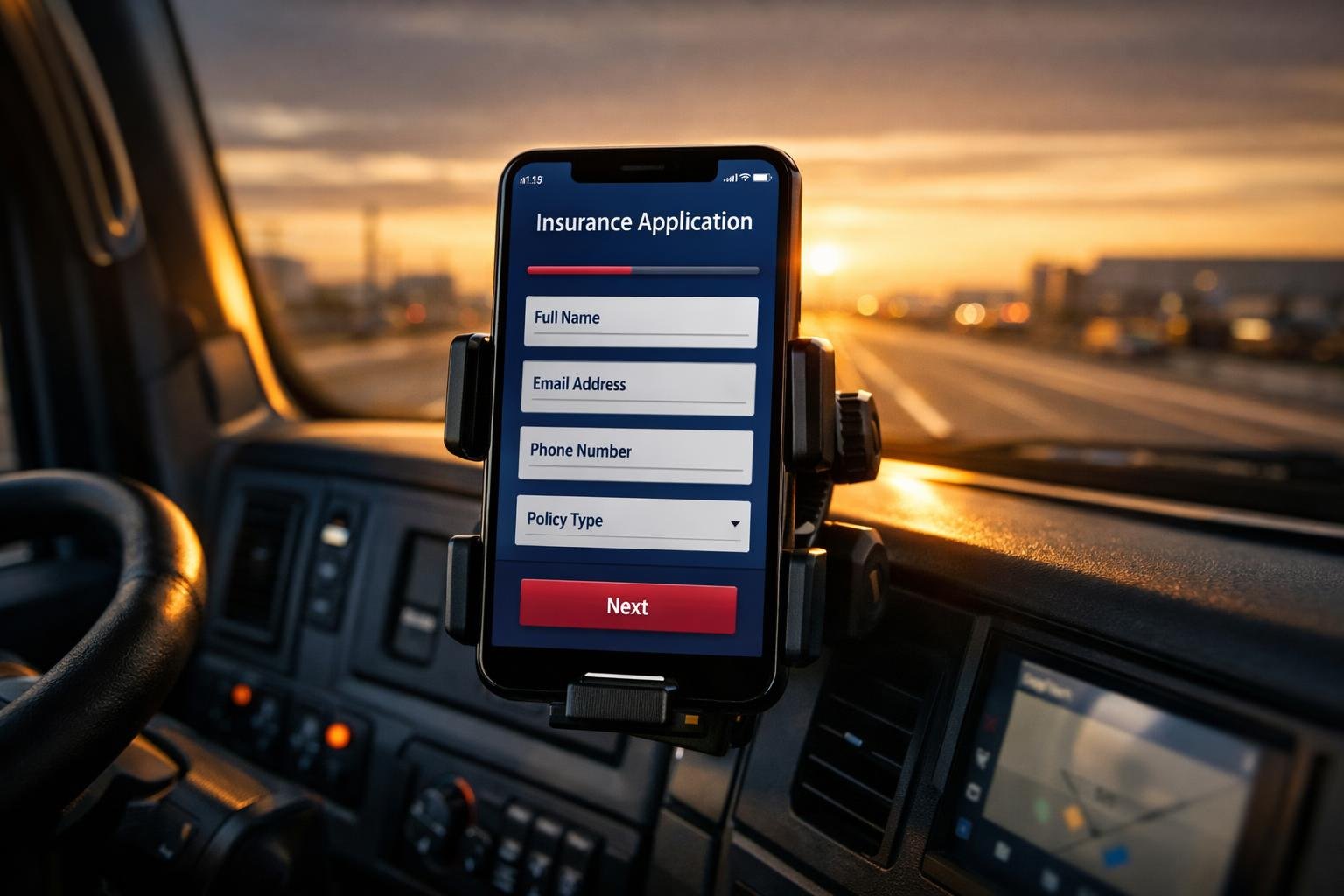
Last week, a driver in a carrier’s onboarding queue opened a text message, tapped a link, and completed a phone-first OAI application from the cab of his truck in nine minutes. The producer who sent that link was still at lunch when the completed application landed. Before the office closed, coverage was bound. No PDF attachments, no printing, no “sign it and fax it back,” no week of chasing a half-finished form. That is the entire case for phone-first enrollment, and it is why multiple agencies now treat it as the default way they place Occupational Accident Insurance.
If your agency writes transportation, last-mile delivery, staffing, home health, IT consulting, or any commercial account built on 1099 independent contractors, the application experience is not a back-office detail. It is the difference between a placement that binds this week and a placement that dies quietly in someone’s inbox. Speed at the application layer compounds into speed everywhere else: faster quotes, faster binds, faster certificates, and a client who remembers which agency made it painless.
What a Phone-First OAI Application Looks Like From Your Seat
The mechanics from the producer’s chair are deliberately boring. You send one link. That link opens your agency’s co-branded storefront — your logo, your colors, your producer information pre-filled on every form. The participant completes the application on the device already in their pocket. The account owner completes their side the same way. Nothing is printed, scanned, or re-keyed by your staff.
Here is the full sequence, end to end:
- You send the link. By text, by email, or embedded in the collateral your agency already hands to clients. The participant sees your brand, not ours.
- The application happens on a phone. Drivers and contractors are not sitting at desks. A phone-first OAI application meets them in a parking lot, a break room, or a job site — and gets completed there, in minutes.
- The quote comes back in hours, not days. The program is built to quote and bind inside a business day, which means your client’s onboarding pipeline never stalls waiting on coverage.
- Coverage binds and documents flow. Confirmation and certificates move automatically. Your team is not the courier between the client and the program.
That is the whole workflow. The point is not that it is clever. The point is that your agency captures the revenue and the client relationship while the rails do the labor.
Paper Applications Are Where Placements Go to Stall
Every producer has lived the other version. A fillable PDF goes out on Monday. Wednesday, it comes back missing two signatures. Friday, the corrected copy arrives, but a date field is blank. The following Tuesday, someone re-scans page three because the fax rendered it unreadable. Two weeks have passed, the client’s new contractors are already on the road, and the placement that should have been a same-week win has become an apology call.
None of that is a coverage problem. It is a distribution problem. The product was fine; the pipe was broken. When the pipe is a phone-first OAI application instead of a paper packet, the failure modes disappear because the steps that produced them no longer exist. There is nothing to print, so nothing prints crooked. Required fields are enforced on the screen, so applications arrive complete the first time. Signatures happen with a fingertip, so nothing waits on a scanner.
For an agency principal, the math is straightforward: every day an application sits in limbo is a day of producer time spent chasing paperwork instead of selling, and a day your client spends wondering whether they chose the right agency. Compress the application, and you compress the entire cost of the placement.
The Rails Behind the Link
A fast application is the visible tip of a larger machine, and the rest of that machine ships to your agency on day one:
- A co-branded storefront, live in a day. Your logo, your palette, your producers pre-filled. An agency sent us a logo on a Tuesday morning; by that afternoon their branded enrollment page was taking applications.
- Twenty-four pieces of print-ready, agency-branded collateral, delivered when you go live — flyers, one-pagers, and sales sheets your producers can put in front of clients immediately. You can preview how co-branding looks with the custom sales sheet generator.
- All-states availability from a single appointment. No state-by-state endorsement grind when your client’s contractors cross a border. One program, nationwide, which matters enormously for trucking and multi-state staffing accounts.
- A documented paper trail of contractor independence, generated as a natural byproduct of digital enrollment — useful backdrop for your commercial clients’ files, handled without any extra work from your team.
The storefront and the collateral are not gestures. They are the reason the phone-first OAI application converts: the participant lands on a page that looks like the agency their company already trusts, with a form built for a five-inch screen.
Speed Is a Closing Tool, Not a Convenience
Producers sometimes file application speed under “operations” — nice to have, not a selling point. That is a mistake. The phone-first OAI application is a sales asset, and its leverage shows up in three places.
New logos
When you are competing for a commercial account that uses 1099 contractors, “we can have your contractors covered this week, and they can apply from their phones” is a line no slow-moving competitor can match. It converts an abstract program pitch into a concrete, near-term outcome the buyer can picture.
Retention
The account that watched you stand up a branded enrollment page and bind coverage in hours does not shop the rest of its book casually. Fast, visible competence on one line of coverage buys patience and goodwill on every other line you hold.
Producer throughput
A producer who is not chasing paperwork places more business. Multiplied across a team and a year, the hours recovered from abandoned fax-and-follow-up loops are a real capacity gain — capacity you can point at the next opportunity on the book. If you want to see where those opportunities already sit, the 1099 exposure identifier will scan an account profile and show you.
Billing That Keeps Pace With the Application
Binding a phone-first OAI application in hours and then billing like it is 1995 would waste the whole effort, so the billing layer matches the enrollment layer. Coverage runs on real-time, pay-as-you-go billing tied to the client’s actual roster — no annual premium guesswork, no month-end reconciliation project for your client’s bookkeeper.
There is also a revenue line hiding in the payment flow: 3% credit card and ACH processing fees are legally passed through to the insured via ePayPolicy. Your agency adds a recurring revenue stream without adding a single piece of back-office overhead. For principals watching margin per account, that pass-through quietly changes the economics of every placement on the program. The full picture of how the program fits a commercial book is laid out on our agency solutions page.
What Going Live Actually Looks Like
Getting appointed is measured in days, and standing up your storefront is measured in hours. You send a logo and your producer roster. We stand up the co-branded page, load your collateral library, and hand you the link. From that moment, every phone-first OAI application that comes through carries your brand on the front and runs on automated rails behind it — quoting and binding in hours while your team stays focused on selling.
Multiple agencies are already live and writing on the platform, and same-day onboarding is the standard, not the exception. If your book has commercial accounts running on 1099 contractors — and it does — the fastest version of this program is the one you start this week. Get appointed here, or reach out directly and we will stand it up.