
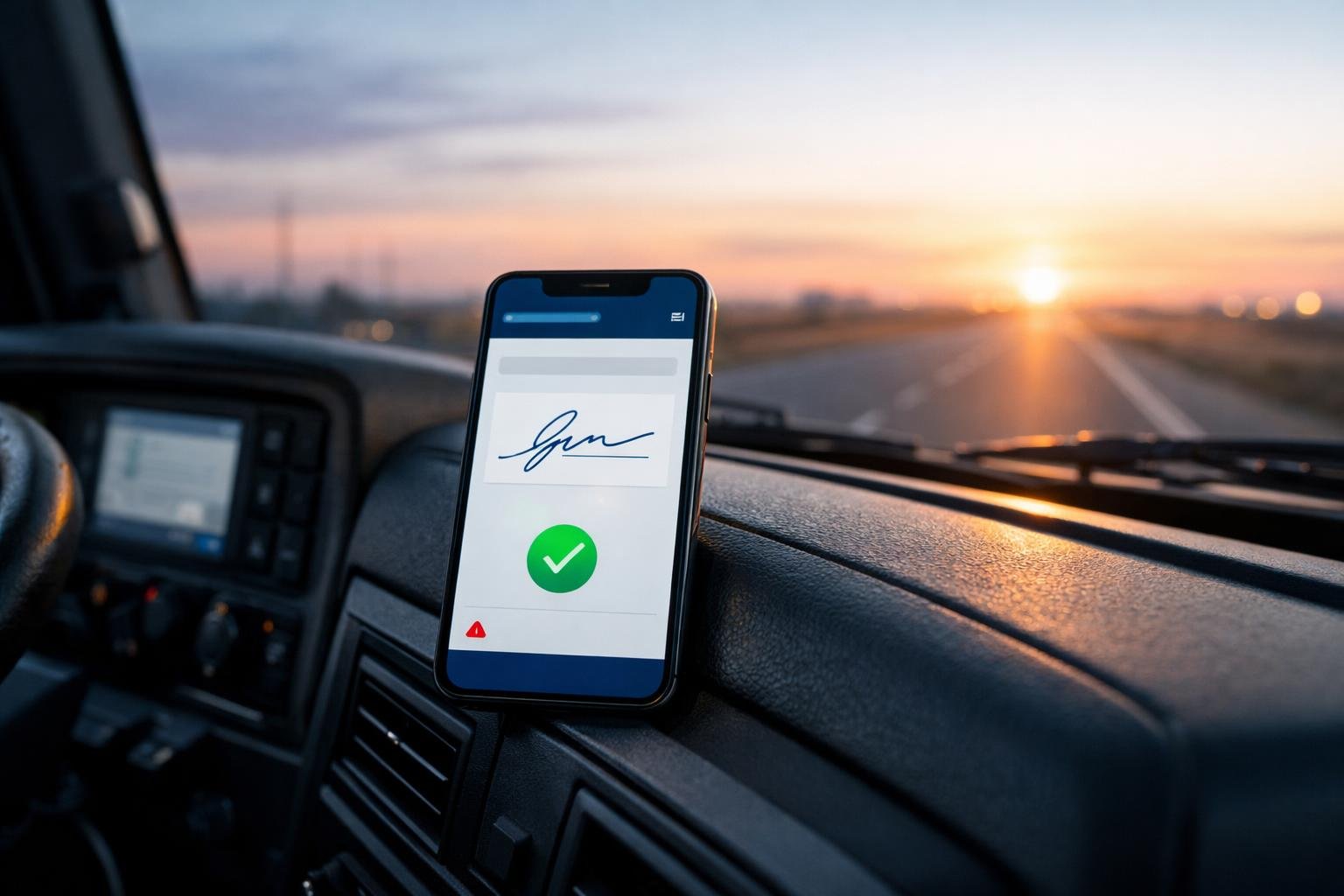
A driver at a fuel island in Amarillo opens a link on his phone at 6:40 in the morning. By 6:52 he has completed an Occupational Accident Insurance application, signed it electronically, and the signed file is sitting in the account record with the agency’s name across the header. Nobody at the agency touched it. That is paperless OAI enrollment, and it is the reason the producer who wrote that motor carrier spent the morning prospecting new logos rather than chasing a signature page across three states.
What Paperless OAI Enrollment Looks Like From the Agency’s Seat
Most agencies that place OAI know the paper chase by heart. The application goes out as a PDF. It comes back scanned sideways, missing a page, unsigned on the acknowledgment, with a date of birth that does not match the license. A CSR emails the dispatcher. The dispatcher texts the driver. The driver is somewhere in Ohio with a load that delivers tomorrow. Three days later the file is finally complete, and only then does the bind request go out.
Paperless OAI enrollment removes every one of those steps. The agency’s co-branded storefront carries a phone-first application. The participant, the 1099 driver, opens it on the device already in his hand, works through the fields in the order they need to be completed, and signs with a finger. Required fields are required, so an incomplete application cannot be submitted. The signature lands on the document at the moment of signing, with a timestamp. The completed file is stored with the account, visible to the agency and to the account owner, meaning the motor carrier or business that engaged the driver.
From the agency’s seat, the file simply appears finished. There is no version to reconcile, no scan to rotate, no signature page to request a second time. The producer sees a completed application with their own name already on it, because the storefront was built with the producer’s information pre-filled into every form. Attribution is never a question, and every enrollment credits the agency that earned the account.
Why the Signature Was the Step That Broke Everything
Ask any agency where a bind actually stalls, and the honest answer is almost never underwriting. It is the signature. The application was substantively complete on day one. The bind waited on a page that needed a driver’s handwriting, and the driver was moving freight. Speed to bind is the number agencies quote to each other, and it is the number that wins the renewal conversation, yet the number was being decided by whether a driver had a printer in his sleeper cab.
Signing inside the application closes that gap because the signature is collected inside the same session as the application. There is no second document, no second touchpoint, and no second reminder. When the participant taps submit, the application and the signed acknowledgment are a single completed record. Quote and bind in hours becomes the default outcome instead of the outcome the agency has to fight for on every account.
The File That Builds Itself
Every enrollment produces a complete, documented file: the signed application, the participant’s acknowledgment of independent contractor status, the timestamp, and the record of who submitted it and from which device. The agency does not assemble this. It is the by-product of the enrollment itself. Later, when an account owner wants a copy, or when a producer needs to confirm exactly what was signed and when, the answer is one click inside the account rather than an afternoon in the email archive. The documented paper trail of contractor independence matters to the account owner as a backdrop; the point for the agency is that the file exists without anyone at the agency building it.
The Rails Behind Paperless OAI Enrollment
The signature is one moment in a larger machine, and the machine is what agencies are actually buying when they get appointed. Here is what stands behind the storefront and makes the signature moment possible.
A Co-Branded Storefront Live in a Day
The agency sends a logo and brand colors. Within a day there is a branded enrollment page carrying the agency’s identity on the front and our rails behind it. An agency sent us a logo on a Tuesday morning; that afternoon their branded page was taking applications. The co-branded collateral library follows the same pattern: 24 print-ready pieces in the agency’s brand, delivered on day one, so the producer walks into the first meeting with material that already looks like theirs.
Phone-First Applications
The application is designed for a phone because that is where the participant is. Owner-operators, last-mile drivers, traveling nurses, and contract engineers do not sit at desks waiting for PDFs. An enrollment flow that only works on a laptop is not paperless in any way that matters. The forms are built mobile-first, sectioned so a driver can complete them in a truck stop parking lot between a fuel stop and a pre-trip inspection, and they capture the signature inside the same flow.
Pay-As-You-Go Billing That Syncs to the Roster
When a participant enrolls, billing reflects the participant. When one leaves, billing reflects that too. There is no annual premium audit, no estimated payroll to reconcile, and no true-up conversation at renewal that turns a happy account into an unhappy one. Real-time, pay-as-you-go billing is the same machine logic applied to money: the record updates itself, and the agency does not have to chase anything on the billing side either.
Fee Pass-Through as a Revenue Line
The 3% credit card and ACH processing fees are legally passed to the insured through ePayPolicy. For the agency, that is a revenue line that requires no new back office, no new staff, and no new process. It runs on the same rails as enrollment and billing, which means it started earning the day the storefront went live.
All States, One Storefront
The storefront enrolls participants across all states without state-by-state endorsements. A motor carrier with drivers domiciled in eleven states enrolls them through one page, on one form, with one file per participant. For a trucking-focused agency, that alone changes what a multi-state account looks like to write. There is more on how the program fits trucking and owner-operator accounts for agencies that specialize there.
What Going Paperless Does to an Agency’s Week
The practical effect shows up in the calendar. Time that used to go to signature follow-ups goes to new logos. Service requests that used to land on a CSR’s desk are handled inside the storefront by the account owner and the participant. Renewal conversations stop being about billing reconciliations because there are none to have.
Multiple agencies are live on the platform and writing this way today, and same-day onboarding is the standard. The agencies adopting paperless OAI enrollment are not doing it because paper is inconvenient. They are doing it because the completed file is the bind, and the bind is the revenue.
A Concrete Week
Monday: a producer sends the storefront link to a motor carrier prospect with twenty-two owner-operators. Tuesday: the dispatcher forwards it to the drivers. By Wednesday afternoon, nineteen of the twenty-two have enrolled from their phones, signed, and bound. The three stragglers finish over the weekend when they get home. Nobody at the agency printed, scanned, or emailed a single page. The producer’s name is on every one of the twenty-two files, and the account owner can see the full roster from the same page the drivers used.
Compare that to the same week on paper. The producer emails a PDF on Monday. Five come back by Wednesday, two of them unsigned. The CSR spends Thursday on follow-ups. The account binds in pieces over the next two weeks, and the producer is still answering questions about who is covered as of which date. Same account, same drivers, same premium. The only difference is whether the agency was running on rails or running on a printer.
This Is What Going Live Looks Like
Paperless OAI enrollment is not a feature bolted onto an old process. It is the process. The agency’s brand on the front, our rails behind it, the participant signing on a phone, and the file finishing itself the moment the signature lands. Everything downstream, from billing to the fee pass-through to the multi-state roster, runs on the same machine.
If your agency is placing OAI on paper, or waiting days for a bind that stalled on a signature page, the fix is a co-branded storefront that takes applications by tomorrow afternoon. Get appointed and we stand it up.