
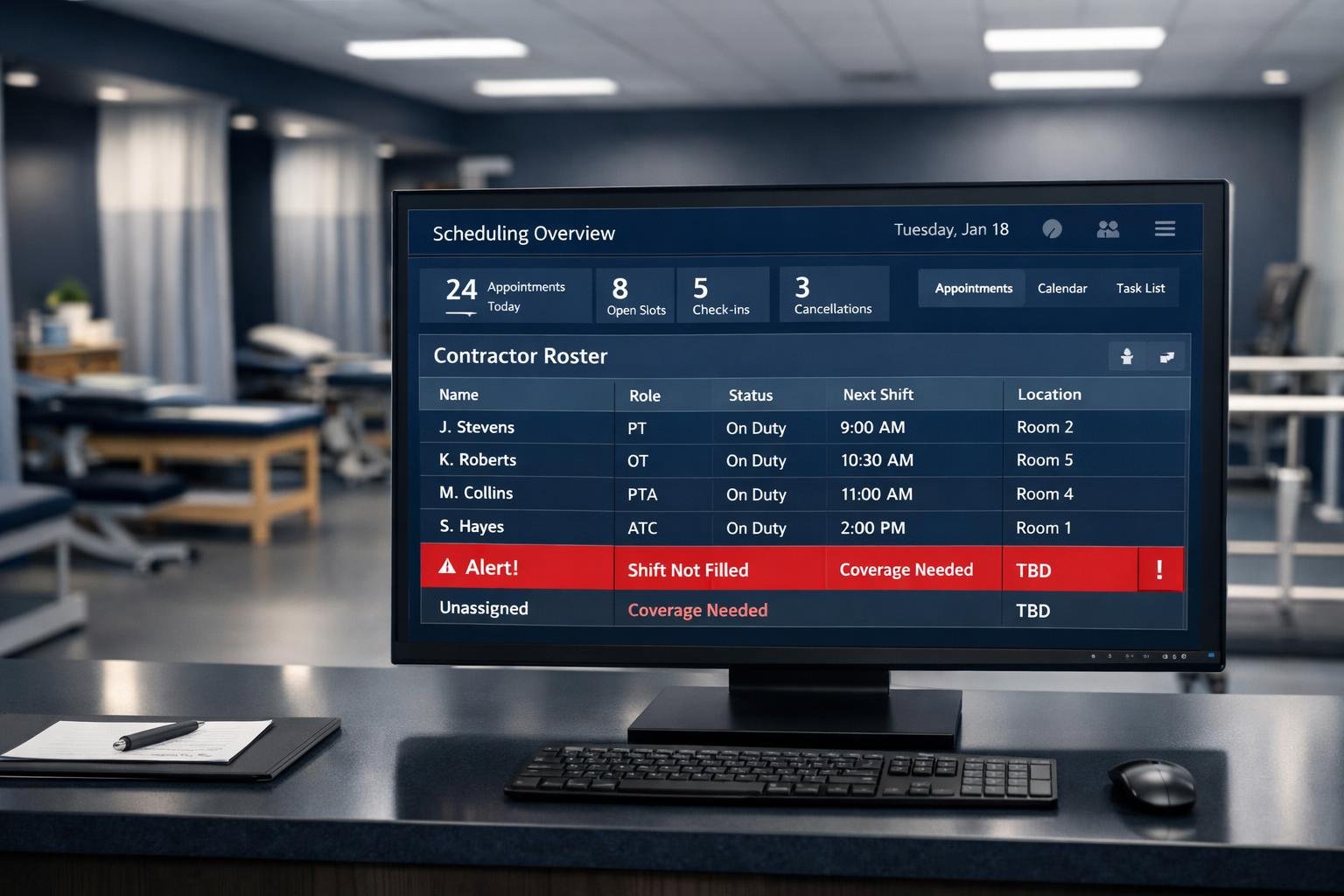
The outpatient PT clinic you renew every February — the one with the rotating bench of per-visit therapists who also work two other clinics across town — is the cleanest cross-sell on your desk. You already carry their general liability and professional E&O. You already have the certificate in your file. What you are not writing yet is the coverage that sits on top of their independent contractor roster, and that gap is a new revenue line you can open on the next renewal call.
Why allied health 1099 insurance is the cross-sell you are missing
Outpatient rehabilitation is a contractor-heavy corner of healthcare. Physical therapists, occupational therapists, and speech-language pathologists routinely work per-visit or per-diem across multiple clinics — covering caseload surges, vacation gaps, and specialty cases the staff therapists do not handle. These are the offices and clinics of health practitioners that fall under SIC code 8049, and they sit on the commercial book of nearly every agency that writes a few medical accounts.
Here is what most producers overlook: when that 1099 therapist tweaks their back transferring a patient or slips on a wet treatment-room floor, the clinic owner’s general liability does not respond to the therapist’s own injury, and their workers’ comp policy does not cover a contractor who is not a W-2 employee. The therapist is a 1099 independent contractor. That is exactly the worker allied health 1099 insurance — Occupational Accident coverage through the WORK Program — is built to protect. Workers’ Comp is for W-2 employees. The WORK Program is for the 1099 economy. They are legally distinct tools for legally distinct workforces.
The per-visit therapist model is growing — and so is the cross-sell
This is not a shrinking niche. Therapist staffing shortages, the shift toward value-based and outpatient care, and clinic owners’ need to flex capacity without adding fixed payroll have all pushed outpatient rehab deeper into the per-visit and PRN model. A pediatric speech clinic that books a contract SLP two afternoons a week, a hand-therapy practice that brings in a per-diem OT for a caseload spike, an orthopedic rehab group that keeps three PRN physical therapists on call — every one of those arrangements is a 1099 engagement, and every one of them widens the exact exposure that goes uncovered today. As the contractor bench grows, the premium opportunity on the account grows with it. The clinics that lean hardest on flexible therapist labor are the ones where this coverage matters most, and they are already on your renewal calendar.
The named account on your book: SIC 8049 rehab clinics
You do not have to prospect for this. Pull your commercial accounts coded under 8049 — outpatient PT practices, OT and hand-therapy clinics, speech and pediatric-therapy centers, multi-disciplinary rehab groups. Any one of them running a per-visit therapist bench is carrying sustained 1099 engagement, and most of them have no Occupational Accident coverage on those contractors at all. The clinic owner assumes the therapist’s malpractice tail or their own GL has it handled. It does not.
When you open the account file, the tells are easy to spot: contracts that describe therapists as “per-visit,” “per-diem,” “PRN,” or “contract,” 1099s issued instead of W-2s, and a staff roster that turns over by season. Any of those flags means the clinic is running independent clinical labor that nothing on the current program protects for on-the-job injury. That is your cross-sell, sitting in a file you already manage.
That gap is your opening. You are not selling them a policy they have to be scared into. You are showing a clinic owner that the contractors keeping their schedule full have an uncovered injury exposure, and that the fix is a small, pay-as-you-go line that rides alongside the coverage you already place. The same pattern shows up across the healthcare verticals you already write — staffing, home health, telehealth — and we break the account types down on the healthcare program page.
Why the WORK Program wins this account
The reason allied health 1099 insurance is an easy add rather than a hard sell comes down to how the program is built for a rotating clinical bench:
- Bind in hours, not days. A clinic that brings on a per-visit therapist mid-week is not waiting a sales cycle for coverage to attach.
- Real-time, pay-as-you-go billing. The premium flexes with the actual contractor roster. No annual premium audit, no true-up surprise when the per-visit bench grows in busy season.
- All-states availability. A speech pathologist credentialed across state lines or a clinic with locations in two states is covered without state-by-state endorsements.
- 3% card and ACH fees passed to the insured. The clinic absorbs the processing cost through ePayPolicy, not your agency.
- Co-branded collateral. You hand the clinic owner a sheet with your agency’s name on it, generated through the Custom Sales Sheet Generator.
And there is a defensibility angle that lives in the background of every one of these accounts. The enrollment paper trail documents each therapist’s independence — their own credentials, their multi-clinic work, their contractor agreement. If a state agency ever questions the clinic’s classification of its therapists, that documentation is already on file. You lead the conversation with the new coverage and the new revenue; the audit-defense backdrop is a quiet bonus, not the pitch.
Run the exposure scan before the renewal call
Before you pick up the phone for that PT clinic’s February renewal, run their book through the 1099 Exposure Identifier. It surfaces the contractor-injury gap on a named account in language a clinic owner understands, and it gives you the opening line: “Your per-visit therapists are not covered for their own injuries under anything you carry today — here is the fix.” Walking into the renewal with the gap already mapped turns a routine policy review into a coverage expansion the owner did not know they needed, and it positions you as the producer who caught what their last agent missed.
The cross-sell math
This is the part that makes allied health 1099 insurance worth the five-minute add to a renewal you are already running. A mid-size outpatient rehab clinic with a handful of per-visit therapists is typically a low-four-figure annual Occupational Accident premium — roughly $1,500 to $4,000 depending on the size of the contractor bench. That is a premium add on an account where you already hold the GL and the professional E&O, where the relationship is already yours, and where the certificate is already in your file. There is no new logo to chase, no appointment friction, no book transfer. It is found revenue on a renewal you were going to make anyway, and it makes the whole account stickier — a clinic that places three lines through you is far harder for the next producer to unwind.
Multiply that by every 8049 account on your book and the math stops being a single add and starts being a book-rounding play. Ten rehab clinics at an average of $2,500 in new Occupational Accident premium is $25,000 of fresh revenue layered onto relationships you already own, plus the retention lift that comes with every additional line you place. Get appointed and you can start scanning your 8049 accounts this quarter. The path to writing this coverage runs through our agent partnership page — we appoint fast, so the next rehab-clinic renewal on your calendar can carry the cross-sell.