
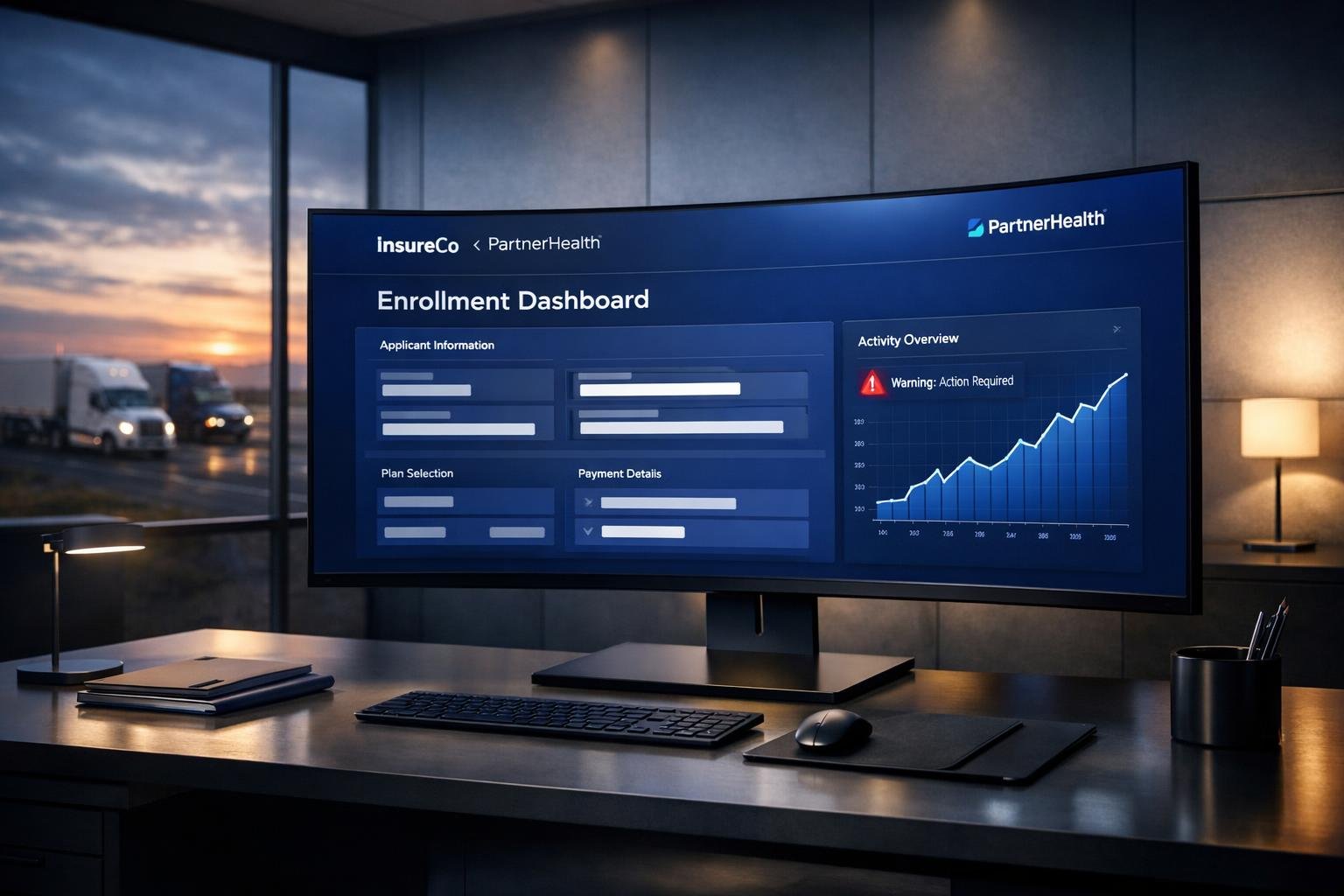
An agency sent us a logo on a Tuesday morning. That Tuesday afternoon, their branded enrollment page was taking applications. No development ticket, no vendor kickoff call, no six-week implementation plan. An agency-branded storefront is not a project you schedule for next quarter. It is a link that exists by the end of the business day, carrying your name across the top and your producer’s name on every application that comes through it.
That is what going live actually looks like on this program. Below is the machine from the agency’s seat, piece by piece.
What an Agency-Branded Storefront Actually Is
It is a public web page under your agency’s identity where your clients and their 1099 workforce enroll in Occupational Accident Insurance coverage. Your logo sits at the top. Your brand colors carry through the buttons and headers. Your producer is pre-filled on every form, so the application lands attributed the moment it is submitted – no manual assignment, no orphaned leads sitting in a shared inbox waiting for someone to claim them.
In the agency-branded storefront model, the reader’s agency is the brand on the front. We are the program provider behind it. Your client sees your agency, sends applications to your agency, and renews with your agency. Nothing in the enrollment path introduces the account to anyone else.
The Three Things That Make It Work
- Identity. Logo, colors, agency name, producer attribution baked into the page and the documents it generates.
- Distribution. One URL. Text it, email it, drop it in a client onboarding packet, or put it behind a QR code on a printed flyer.
- Speed. Applications route straight into underwriting. Quote and bind happen in hours, not days.
Day One: The Twenty-Four Piece Collateral Library
An agency-branded storefront with nothing pointing at it is a parked asset. So the storefront does not ship alone – it ships with 24 pieces of print-ready, agency-branded collateral delivered on day one. Driver-facing flyers your client can hand out at a terminal. Owner-facing one-pagers your producer can leave behind after a commercial renewal meeting. Enrollment instructions your client’s back office can post on a break room wall.
Every piece carries your agency’s mark, not ours. If you want to spin up a variant for a specific account, the co-branded sales sheet generator produces one on demand. Most agencies find the collateral is what converts the agency-branded storefront from a link into a placement channel, because it gives the producer something physical to put in a client’s hand while the conversation is still warm.
Phone-First Applications Because That Is Where the Workforce Is
The people enrolling are not sitting at a desktop. They are in a truck cab at a fuel island, in a van between stops, in a hospital parking lot between shifts. A paper application asks them to find a printer. A desktop-only portal asks them to find a laptop. Both are how enrollment dies.
The application on your storefront is built to be completed on a phone in about five minutes. Large tap targets, short field groups, no PDF download step, no wet signature requirement. The practical effect for the agency is that the enrollment rate on a given account stops being a function of how hard your account manager chases paperwork.
What Happens After Submit
The application lands with your producer attached. Underwriting reviews on the same business day in the ordinary case. Coverage binds in hours. The participant – the 1099 worker being covered – gets confirmation of active coverage, and the Account Owner – the hiring business – gets a clean record of who is covered and when the coverage started. That record accumulates into a documented paper trail of contractor independence, which sits quietly in the file until the day someone needs it.
Real-Time Billing and the Fee Line You Are Currently Giving Away
Billing runs pay-as-you-go and in real time. Coverage counts adjust as the roster moves, which means your client is not writing a check against an estimate and then arguing about a reconciliation months later. For the agency, that removes an entire category of service call – the one where a client calls angry about a bill they do not understand.
The part most producers underweight: through ePayPolicy, the 3% credit card and ACH processing fee is legally passed to the insured. On most books, that fee is silently absorbed as a cost of doing business. Here it is a revenue line that requires no new back office, no new staff, and no new software for the agency to run. It arrives switched on with the storefront.
All States, One Appointment
Your client signs a contract with a shipper in three new states on Friday. Under a state-by-state endorsement structure, that is a filing question, a turnaround delay, and a phone call where you tell a growing client to wait. On this program, availability runs across all states through federal preemption – no state-by-state endorsements to chase.
The distribution consequence matters more than the technical one. Your agency stops being geographically capped on this line. A trucking account that expands its lanes, a staffing firm that opens a second region, a last-mile operation that adds a new metro – none of them require you to go back to square one. If you write motor carriers and owner-operator fleets, you already know how often that call comes.
The Storefront as a Closing Tool on New Logos
There is a second use for an agency-branded storefront that has nothing to do with servicing an existing account: it wins new ones. When a producer walks into a prospect meeting and can pull up a live page with the prospect’s coverage path already running under the agency’s brand, the conversation stops being a proposal and starts being a demonstration. The prospect is not evaluating a promise about capability. They are looking at a working system with the agency’s name on it.
That matters most on accounts with sustained 1099 engagement – staffing firms rotating contract talent, motor carriers running owner-operators, last-mile operations onboarding drivers in waves, IT consultancies with a bench that turns over quarterly. Those buyers have been told before that enrollment will be easy. Showing them a phone-first application they can complete in front of you, on their own phone, in five minutes, ends that objection permanently. Producers who lead with the storefront generally find that objection does not resurface.
What Going Live Requires From You
Everything the agency-branded storefront needs from you fits on a short list:
- Get appointed. The paperwork is light and the turnaround is days, not weeks.
- Send a logo file and your brand colors.
- Name the producers who should appear on applications.
That is the input. The storefront, the collateral library, the phone-first application flow, the billing rails, and the fee pass-through come back assembled. Multiple agencies are live and writing on the platform today, and same-day onboarding is the standard, not the exception.
There is no book transfer required and no exclusivity demanded. You can quote in parallel with whatever you place today and let the speed-to-bind decide it for you. Most producers who run that test stop running it after the second account.
Why Agencies Build the Storefront Before They Need It
The agencies that get the most out of this do not wait for a client to ask. They stand the agency-branded storefront up, put the collateral in front of two or three existing accounts with sustained 1099 engagement, and let the first placement fund the habit. An agency-branded storefront is live in a day, so the cost of standing it up early is effectively zero – and the cost of standing it up late is a client who asked a question you could not answer in the moment.
If you are already placing this coverage somewhere else, the storefront is a better placement with a faster bind and a fee line you are not currently collecting. If you are not placing it at all, it is a new revenue line on accounts you already own. Either way, the build is the same and it takes a day.
Stand It Up
Send a logo. Get an agency-branded storefront. Start writing. Get appointed and we will have your agency-branded storefront taking applications before the week is out. That is the move.