
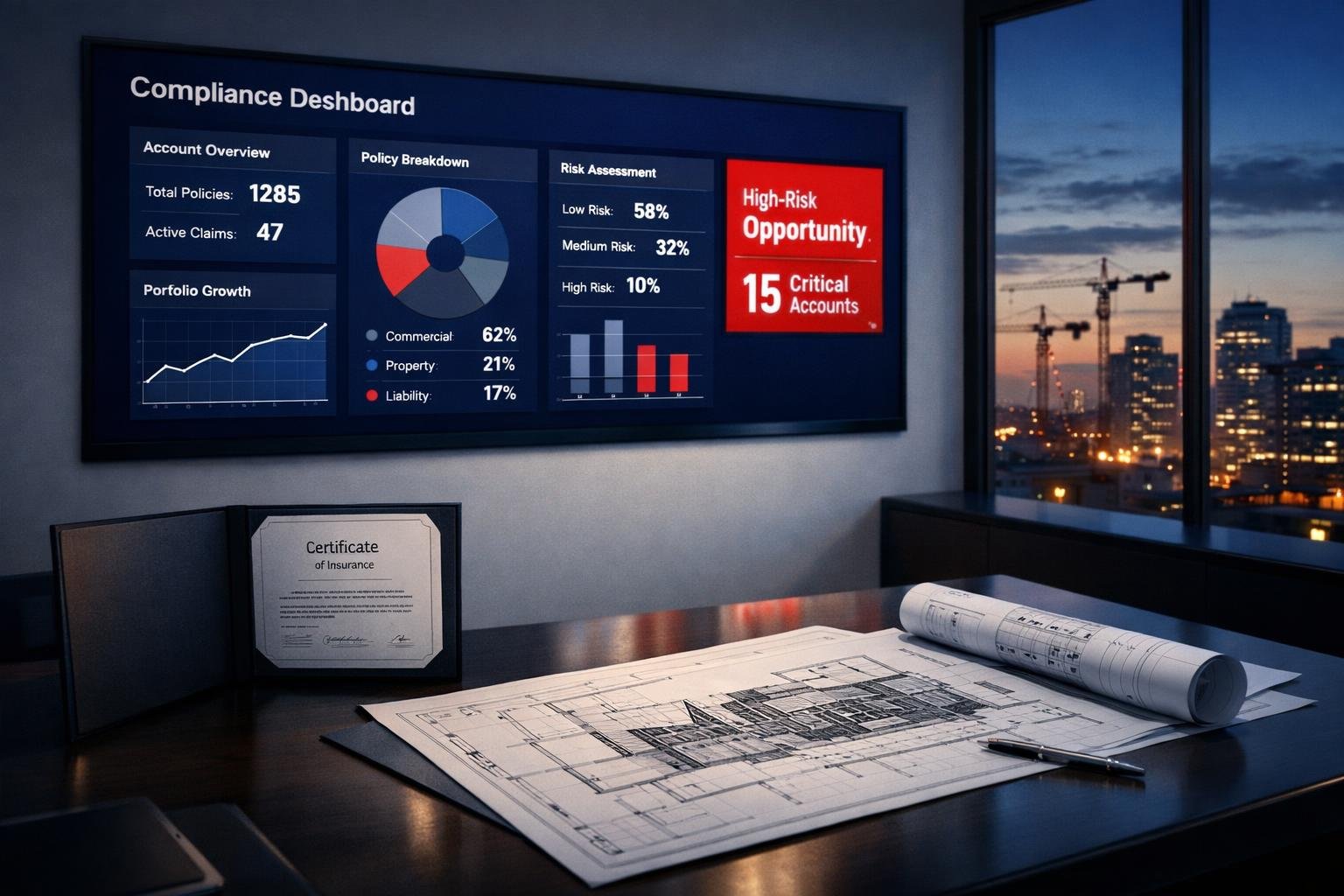
Somewhere on your book right now is a general contractor account you will renew this quarter exactly the way you renewed it last year: general liability, commercial auto, an umbrella, and a certificate folder full of subcontractor COIs. The producer who takes that account from you next year will not beat you on any of those lines. They will quote the one line you never mentioned. The 1099 cross-sell sitting on a GC account is the most obvious revenue line most commercial producers never touch — and on SIC 1521 and 1542 accounts, the evidence that the cross-sell exists is already in your own file cabinet.
Multiple agencies are writing this line on our rails today, and the pattern repeats every time: the account was already on the book, the relationship was already owned, and the premium was sitting there waiting for someone to quote it. Here is the play, the math behind it, and what delivery actually looks like from your seat.
Why GC Accounts Are Built for the 1099 Cross-Sell
A residential or commercial general contractor runs on a rotating bench of 1099 subcontractors — framing crews, electricians, drywall and finish carpenters, concrete and equipment operators. The engagement is sustained, not incidental: the same trades cycle across projects all year, every year. That is precisely the profile where Occupational Accident Insurance belongs, because those workers are independent contractors, and your client is the hiring entity that benefits when every one of them carries real injury coverage.
Here is what makes the GC vertical different from cold-prospecting a new niche: you already hold the proof. Every subcontractor certificate in your COI folder documents a standing 1099 relationship. You do not need to ask the client whether they engage independent contractors — you have been tracking the paper for years. The 1099 Exposure Identifier turns that folder into a shortlist in minutes: run your GC accounts through it and you have a ranked list of 1099 cross-sell conversations before your second coffee.
The 1099 Cross-Sell Math on an Account You Already Own
Producers underrate this line because they price the effort like a new logo. It is not a new logo. There is no acquisition cost, no cold outreach, no competitive quoting war. The relationship, the renewal calendar, and the trust are already yours. The 1099 cross-sell adds a recurring revenue line to an account whose service cost you are already carrying — which makes it close to pure margin on the agency P&L.
Consider the time cost, too. A producer can spend sixty days courting a new commercial logo that may never close. This cross-sell conversation happens inside a renewal meeting that was already on your calendar, with a client who already returns your calls. Same hour of work, radically different conversion odds.
Three ways the math compounds:
- New recurring revenue. Per-participant, pay-as-you-go premium that scales with the client’s roster. When your GC staffs up for a heavy season, the premium grows with the roster — and there is no annual true-up battle, because billing runs in real time.
- Retention. Multi-line accounts leave slower. A GC who holds general liability, commercial auto, and a 1099 program with you has three reasons to ignore the next producer who calls.
- Closing leverage on new logos. Walk into a GC prospect with the line their incumbent never quoted, and you have changed the conversation from “match my premium” to “why hasn’t my current agent mentioned this.”
The $500K Number That Makes the Conversation Land
You do not need to sell this line on dread, and you should not. But the client conversation needs one piece of substance, and it is this: pre-trial defense of a single 1099 contractor injury suit can clear $500,000 before a verdict is ever reached. When every subcontractor on the roster carries Occupational Accident Insurance, an injury has a coverage path — accident medical, disability income, accidental death benefits — and your client holds a documented paper trail of contractor independence. Treat that number as backdrop, not the pitch. The pitch is the revenue line and the client experience; the backdrop is why the client says yes in one meeting instead of three.
What Delivery Looks Like From Your Seat
The reason most producers never quote this line has nothing to do with demand. It is that legacy programs made distribution miserable: paper applications, slow underwriting, monthly billing reconciliation the agency ends up policing. The rails behind this program were built to delete that friction entirely.
- A co-branded storefront, live in a day. Your logo, your colors, your producer pre-filled on every form. An agency sent us a logo on a Tuesday morning; their branded enrollment page was taking applications that afternoon.
- Phone-first applications. A subcontractor completes enrollment from the cab of a truck or the tailgate at a job site in about five minutes. No PDFs, no wet signatures, no chasing.
- Quote and bind in hours, not days. Your client’s crews are covered before the week is out, and you look like the fastest-moving vendor in their stack.
- Real-time, pay-as-you-go billing. Premium tracks the actual roster, month by month. Your service team never referees a year-end reconciliation.
- A fee revenue line with no new back office. The 3% credit card and ACH processing fee passes to the insured through ePayPolicy — legally, automatically, with zero added workflow at your shop.
- All states, one appointment. Federal preemption means no state-by-state endorsement grind when your GC client crosses a state line for a project.
- 24 pieces of agency-branded collateral, delivered day one. Flyers and one-pagers carrying your name, ready to drop into the next renewal packet.
One more thing worth being precise about: we are the program provider, not another agency. Your brand faces the client at every step — the storefront, the collateral, the enrollment confirmation. We build and run the rails behind it. If you want to see how the program plugs into a commercial book beyond construction, the agency solutions overview covers the wider verticals, from IT consultancies to staffing firms.
Run the Play This Week
The sequence is short. Pull your GC accounts — SIC 1521, 1542, and the remodelers and specialty builders clustered around them. Count the subcontractor certificates in each file. Any account with a standing bench of 1099 trades is a live 1099 cross-sell, and the opening line is one sentence: “Your subs cycle all year — there is a coverage program for that bench, it binds in hours, and it runs under our agency’s brand.”
Expect the second meeting to be shorter than the first. Once your client sees the enrollment link carrying your agency’s logo, with your producer already pre-filled on the form, the decision stops being abstract. Most of the remaining questions are operational — who sends the link to the subs, how the billing lands each month — and the rails answer both automatically. That is the point where a renewal defense quietly becomes an account expansion, and where the line you quoted first becomes the reason the whole account stays put.
Then get appointed. Appointment takes days, not months, and the storefront, collateral, and billing rails come standing up with it. Get appointed here, or DM us and we will walk your first GC account through the program together. The account is already on your book. The certificates are already in your file. The only thing missing is the quote.