
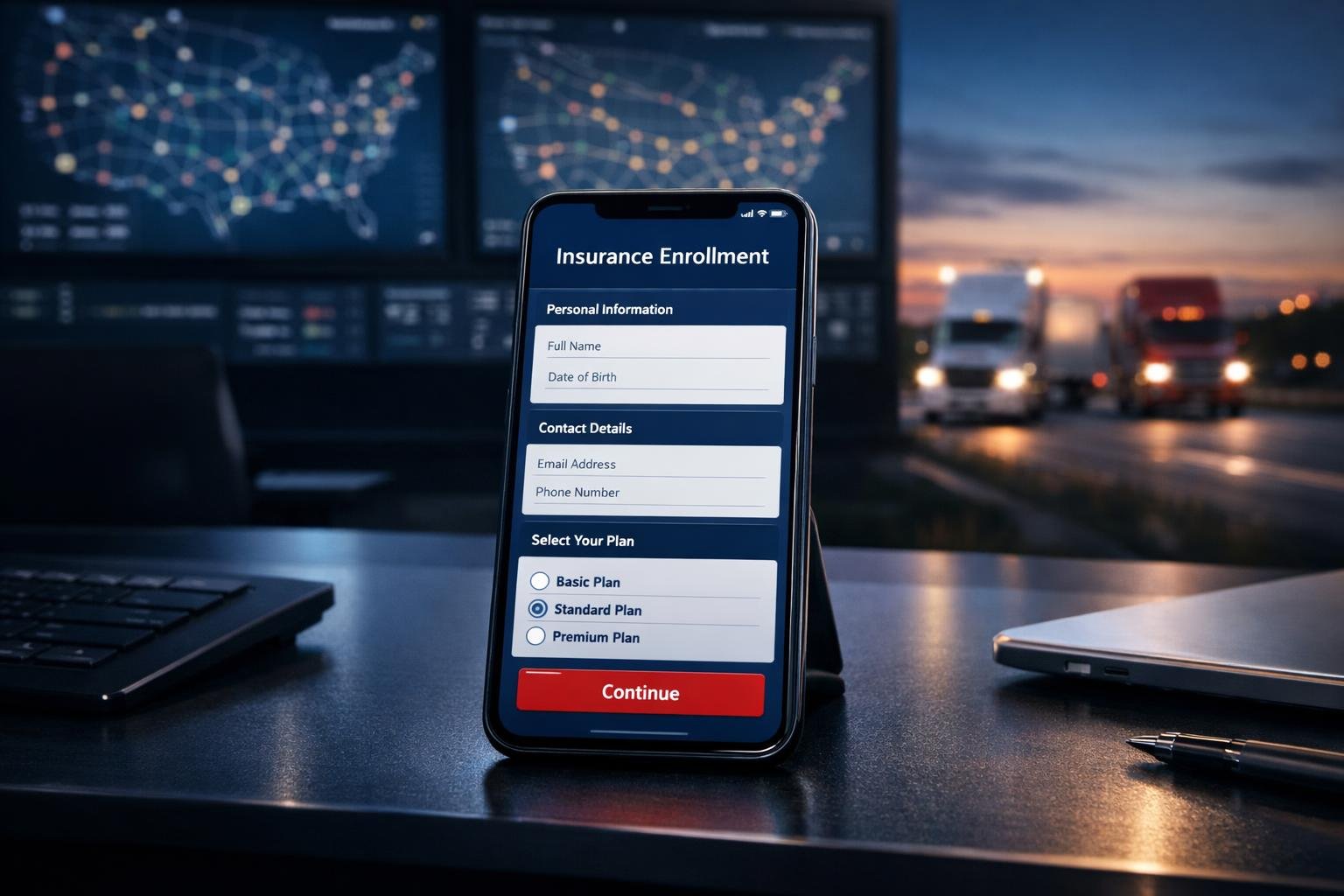
Phone-first insurance enrollment is the clearest signal of where commercial distribution is headed. Within five years, the standard application for 1099 workforce coverage will not be a PDF attached to an email or a form filled out at an office desktop. It will be completed on a phone, in about five minutes, by the worker it covers — with the distributing agency’s brand on the screen and the producer’s information already filled in. Agencies that place programs built for that reality will out-distribute agencies still pushing paper. This is a distribution point of view, not a technology prediction, and the gap between the two camps is already visible in placement speed.
The Application Followed the Workforce Into the Field
The 1099 economy does not sit at a desk. An owner-operator spends the day in a cab. A traveling nurse moves between facilities. An installer works out of a van, an IT contractor out of a client’s server room. For a decade, commercial insurance asked this workforce to behave like office workers anyway: print an application, sign it in ink, scan it, email it back. Every step of that chain is friction, and in distribution, friction is measured in lost placements.
Phone-first insurance enrollment removes the friction at exactly the point where it costs agencies deals. When the application lives on the phone already in the worker’s hand, a driver can complete it from the cab between loads. A nurse can enroll between shifts. The producer never has to chase a paper form across three time zones. For agencies serving trucking and owner-operator fleets, this is the difference between a same-week bind and a placement that dies waiting on a fax machine that no longer exists.
Trucking is the loudest example, but it is not the only one. Healthcare staffing runs on credentialed professionals who move weekly. Last-mile delivery and installation crews are dispatched from a phone to begin with. IT consultancies rotate 1099 engineers across client engagements measured in sprints. In every one of these verticals, the coverage conversation happens in the field, on a schedule the worker controls — and the enrollment experience either meets the worker there or loses them. The agencies that recognize this early are not adopting a gadget; they are matching their distribution to how their insureds actually work.
Speed compounds downstream
A phone-first application is not just more convenient — it is structurally faster. Data arrives digital, clean, and complete, which means underwriting can move immediately. On rails built this way, quote and bind happen in hours, not days. Speed at the application layer becomes speed at every layer after it, and the agency holding the faster placement wins the renewal conversation before it starts.
What Phone-First Insurance Enrollment Actually Requires
The phrase gets used loosely, so it is worth being precise. A PDF that technically opens on a phone is not phone-first insurance enrollment. The real standard has four working parts:
- A co-branded storefront. The agency’s logo, colors, and producer information pre-filled on every form — so the enrollment experience builds the agency’s brand, not the program provider’s.
- Digital signature and submission. No print, no scan, no ink. The application is complete the moment the worker taps submit.
- Real-time, pay-as-you-go billing behind it. Coverage that activates and bills as the roster actually works, in place of estimated annual premium reconciled by a year-end audit.
- All-states availability. One program that follows the workforce across state lines without state-by-state endorsement work.
Multiple agencies are already live on rails built to this standard, and same-day onboarding is the norm rather than the exception. One agency sent over a logo on a Tuesday morning; by that afternoon, its branded enrollment page was taking applications. That is the pace the next five years will treat as ordinary — and agencies can see how the co-branded layer works through tools like the custom sales sheet generator, which turns the same rails into print-ready, agency-branded collateral on day one.
Why Agencies Win the Phone-First Shift
Every structural shift in distribution redistributes revenue, and this one favors the agency, not the program provider. Three reasons.
Faster bind is closing leverage
When a producer can tell a prospect that coverage for their 1099 roster binds in hours, that statement closes business on its own. It also defends the book: an account that enrolled in five minutes on a branded page has very little reason to shop the placement. Speed is both the sword and the moat.
Real-time billing ends the audit argument
Monthly premium true-ups and year-end audits are where commercial relationships go to sour. Pay-as-you-go billing that tracks the actual roster removes the single most common service complaint a producer fields all year. The agency stops litigating estimates and starts renewing quietly.
A new revenue line hiding in the billing stack
On modern rails, the 3% credit card and ACH processing fees are legally passed to the insured through ePayPolicy — which converts a cost the agency used to absorb into margin, with no new back office to build. Combined with commission on a product line most generalist agencies have never placed, phone-first distribution is not just operationally cleaner; it is a new revenue line sitting on the existing book.
The Next Five Years: Four Calls We Are Making
A point of view is only useful if it is falsifiable, so here are four specific calls on where 1099 workforce coverage and distribution land by 2031.
Paper applications disappear from 1099 programs entirely. Not decline — disappear. The workforce being covered lives on the phone; the enrollment layer will finish following it there, and carriers still requiring wet signatures will lose their distribution partners to programs that do not.
Real-time billing becomes the default expectation. The pay-as-you-go model that feels like a differentiator today will be table stakes, the way online banking stopped being a feature and became the definition of banking.
Co-branding becomes the price of distribution. Agencies will stop accepting programs that put the provider’s brand in front of the agency’s client. White-label rails — agency logo forward, provider infrastructure behind — become the standard commercial arrangement, because the agency owns the relationship and will insist the enrollment experience reflect it.
Placement speed becomes a published metric. “Hours, not days” will move from marketing language to a service-level expectation that producers quote to clients the way they quote premium. Agencies distributing on fast rails will advertise it; agencies on slow rails will be asked about it.
None of these calls requires believing in a technology breakthrough. Every capability they describe is running in production today. What they require is a bet on distribution behavior: that agencies, given the choice between rails that make them faster and more visible to their own clients and rails that do not, will migrate to the former. Distribution history says that bet pays.
Where the Rails Already Exist
None of this requires waiting for 2031. The storefront, the phone-first application, the real-time billing, the all-states program, the branded collateral — the machine is running now, and multiple agencies are writing on it today. For an agency principal or producer looking at the next five years of commercial distribution, the practical question is not whether phone-first insurance enrollment becomes the standard. It is whether your brand is on the screen when it does. If you want your agency on these rails, get appointed and we stand it up — typically live in a day.