
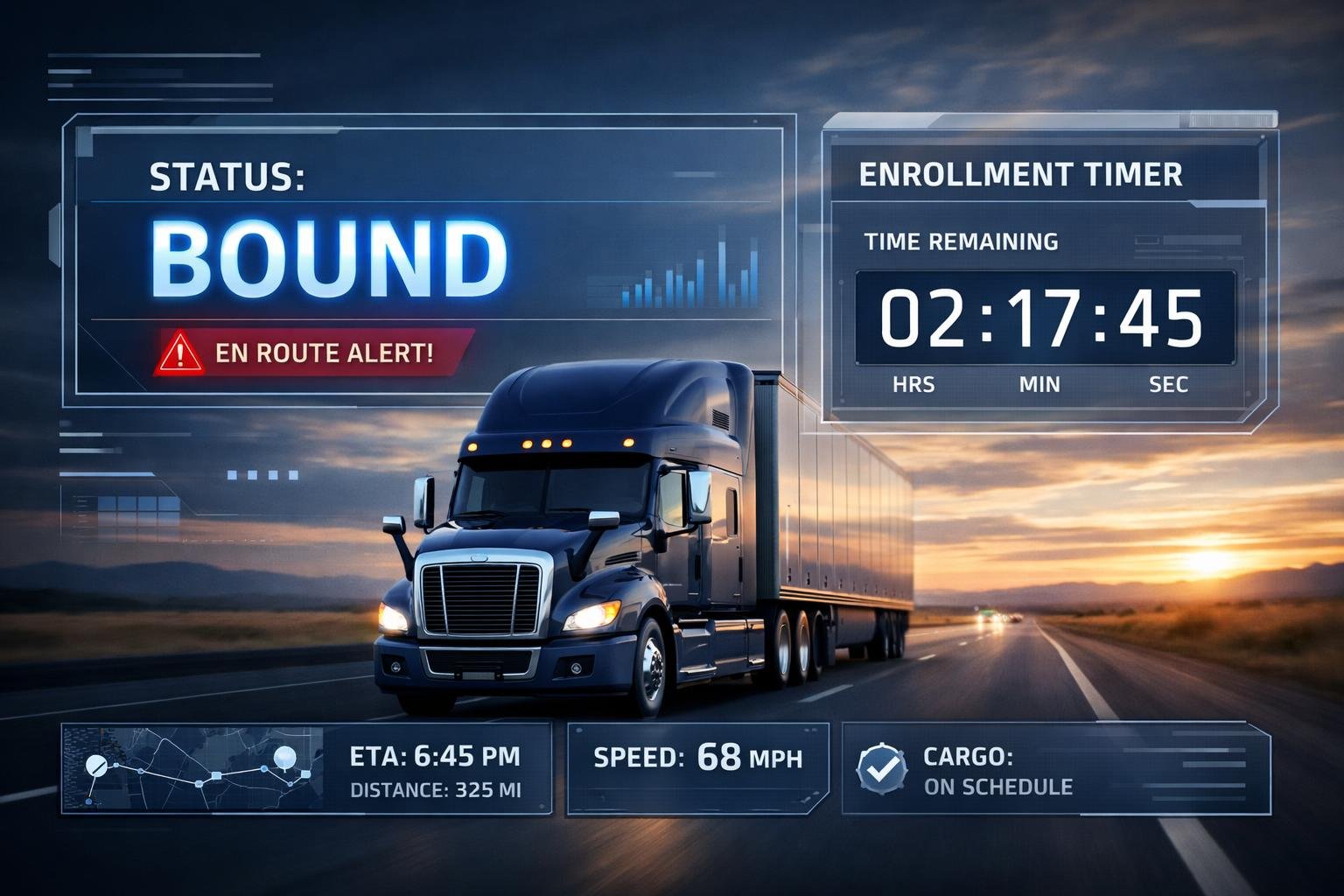
If your current OAI carrier still takes four days to bind a new owner-operator, your best fleet client is already taking calls from the agency down the street. OAI speed-to-bind stopped being a convenience feature a long time ago. For trucking agencies, it is now the single mechanic that decides whether a driver gets seated this week or walks to a competitor who can move faster. The fleets you write do not lose drivers because your service is bad. They lose drivers because the placement behind you is slow, and slow is something you can fix by switching the rails, not the relationship.
This is a producer-to-producer conversation about a placement decision. The product behind your agency should bind Occupational Accident Insurance in hours, put a co-branded enrollment page in your client’s hands the same day, and bill in real time. When it does, retention stops being a hope and starts being a feature you sell.
Why OAI Speed-to-Bind Decides Who Keeps the Driver
Trucking runs on a simple clock. A carrier finds an owner-operator who is ready to roll, and the only thing standing between that driver and a loaded trailer is paperwork and coverage. If the OAI placement behind your agency can seat that driver in an hour, the fleet keeps the load, the driver keeps the income, and you keep the account. If the placement takes three or four days, the fleet either runs the driver uncovered — which no responsible carrier wants — or watches that driver take a seat somewhere else.
Elite owner-operators have options. They are the most mobile workers in the freight economy, and they gravitate to the fleets that onboard them the fastest. When your placement is the bottleneck, your client’s roster churns, and a churning roster is a shopping roster. The carrier starts asking why their agent’s program moves slower than the competition’s, and that question is the first step toward a market check you did not invite.
What Slow Binding Actually Costs Your Agency
The damage from a sluggish incumbent carrier is not abstract. It shows up in three places on your book, and all three are recoverable the moment you move to a faster placement.
The retention leak
Every day a driver waits on coverage is a day the fleet questions the value of your placement. Multi-day binds train your clients to keep a backup quote open “just in case.” That open quote is the wedge a competing agency uses to get a foot in the door. A program that binds in hours closes that wedge before it opens. You are not asking the client to trust a promise — you are showing them a driver seated the same afternoon they sent the application.
The quote-shopping window
Slow service creates idle time, and idle time is when clients shop. When your incumbent carrier needs paper applications, manual underwriting, and a multi-day turnaround, you hand your competitors a window every single time a fleet adds a driver. Real-time, phone-first enrollment collapses that window to minutes. There is nothing for a competitor to slip into when the driver is already covered.
The billing friction tax
Legacy OAI placements still run on annual premium audits and lump-sum billing that punishes fleets for the way they actually operate. Rosters in trucking move weekly. A pay-as-you-go billing model that bills only for the drivers actually running this week removes the year-end true-up surprise that makes clients resent the program — and resentment is the emotion that precedes a switch. When the billing matches the roster, the client stops looking.
The Machine: Quote and Bind in Hours, Not Days
Here is what the faster placement looks like from your seat as the producing agent. You are not learning a new category and you are not transferring your book. You are putting a better engine behind the same client relationship you already own.
The day your agency comes on, we stand up a co-branded enrollment storefront — your logo, your colors, your producer pre-filled on every form. An agency sent us a logo Tuesday morning; Tuesday afternoon their branded enrollment page was taking applications. That is the standard, not the exception. Multiple agencies are live on the platform and onboarding the same day they sign.
From there, the rails do the work:
- Phone-first applications. A driver completes enrollment from the cab on a phone in minutes. No paper, no fax, no back-and-forth.
- Quote and bind in hours. Coverage is real, in force, and documented while the driver is still in front of the dispatcher — not four days later.
- Real-time, pay-as-you-go billing. The fleet pays for the drivers running this week. No annual premium audit, no year-end true-up.
- A 3% credit card and ACH processing fee passed to the insured through ePayPolicy — a new revenue line for the account with no new back office for you.
- All-states availability without state-by-state endorsements, so a 48-state lane does not stall on a jurisdiction your incumbent will not write.
For the owner-operator and long-haul accounts where this matters most, the placement is built for the way modern fleets actually run. If you want the deeper view of how the program seats OAI for owner-operators, the mechanics are all keyed to speed.
Co-Branded Distribution Makes the Speed Visible
Speed only retains a client if the client can see it. That is why the storefront and the collateral matter as much as the underwriting clock. On day one your agency receives a library of print-ready, agency-branded materials your producers can hand to a fleet in the first meeting. When your client sees your brand on a fast, modern enrollment flow — instead of a generic carrier PDF and a four-day wait — the speed becomes a story they tell their drivers. That story is retention you can point to.
This is the difference between selling coverage and selling a distribution experience. The fleets that stay are the ones whose drivers got seated fast and whose billing never surprised them. You own that experience because your brand is on the front of it. The program provider stays invisible behind your rails. We are not your competitor — we are the engine you put your name on. See how the trucking program is positioned for the agencies distributing it.
How the Switch Actually Works — No Book-Transfer Pain
The objection every agent raises is the cost of moving. It is the right question, and the answer is that the move is far lighter than the slow placement you are leaving.
Appointment happens in days, not quarters. You do not have to transfer your existing book to start writing new business on the faster rails — you can run parallel quoting and move accounts as they renew, on your timeline. New drivers go on the co-branded storefront immediately; existing relationships migrate when it makes sense for the account. There is no rip-and-replace, no service gap, and no period where your client is uncovered. You simply add a faster engine and let the speed do the selling.
The math is straightforward. A placement that binds in hours retains the drivers a four-day placement bleeds, adds a processing-fee revenue line you did not have, and ends the annual-audit friction that makes clients shop you. The switching cost is a short appointment process. The cost of staying is the next driver your client loses while the paperwork sits.
The Next Move
If you write trucking and your OAI placement still measures bind time in days, the fix is a faster set of rails behind your same brand and your same client relationships. Quote and bind in hours, a co-branded storefront live in a day, pay-as-you-go billing, and a processing-fee revenue line — all distributed under your agency’s name. That is what going live looks like.
Get appointed and we stand it up. Reach out through our agent appointment page or DM directly, and we will have your branded storefront taking applications before your competitor finishes their next paper bind.