
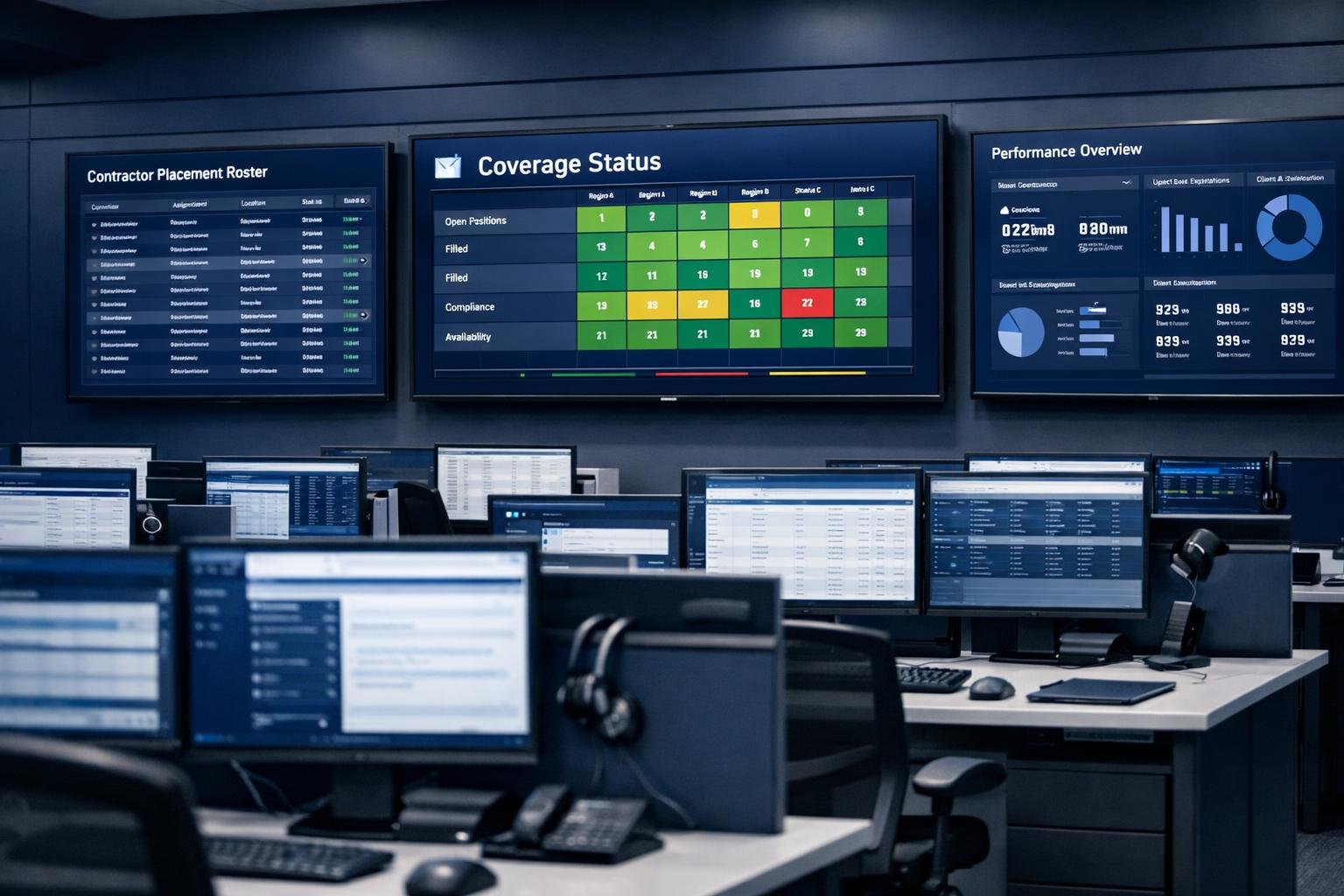
The staffing firm sitting on your commercial book is the densest 1099 cross-sell you have. Look at the account: a help-supply firm placing forty, sixty, a hundred contractors at a time, all classified the same way, all working under the same agreement. You already write their general liability, their professional, maybe their commercial auto. The certificate is already in your file. What you are not writing yet is staffing firm 1099 insurance on that same contractor bench — and that is a clean revenue line you are leaving on the table every renewal.
This is the post for general P&C and commercial producers who write staffing accounts but have never placed Occupational Accident coverage outside of trucking. The category is not new to the trucking desk. It is new to your book. And the staffing vertical — SIC 7363, Help Supply Services — is where the math works hardest in your favor.
Why Staffing Firms Are the Best Staffing Firm 1099 Insurance Cross-Sell on Your Book
Most 1099 cross-sells are one-off. A consultancy with two contractors. An ad shop with a rotating freelancer. The premium is real but small, and the effort-to-revenue ratio is thin. Staffing firms break that pattern because the entire business model is a contractor bench. Help-supply firms exist to place independent workers — light industrial, clerical, warehouse, IT, skilled trades — into client sites. The 1099 engagement is not a side exposure on the account. It is the account.
That changes the cross-sell math completely. Where a typical commercial account carries a handful of 1099 workers, a staffing firm carries dozens to hundreds. The Occupational Accident premium scales with that headcount, which means a single staffing placement can carry more OAI premium than ten small consultancy accounts combined — on a relationship you already own.
The Account You Are Already Servicing
Run your renewal list. Filter for help-supply, temp agencies, light-industrial staffing, and IT staffing shops. Every one of those accounts has a population of independent contractors who get hurt at client job sites — a warehouse temp who tweaks a back, a field tech who falls off a ladder, a delivery placement in a fender-bender. When that worker gets injured, the staffing firm needs a response that protects both the contractor and the firm’s relationship with its client. That is exactly what Occupational Accident coverage delivers, and it is precisely the conversation you can open at the next renewal without a single new logo.
The Cross-Sell, Not the Category Lesson
You do not need a lecture on what OAI is. You need the angle that makes a staffing principal say yes. Here it is: their independent workforce is uninsured for on-the-job injury unless they buy it, and right now nobody is offering it to them as part of the program you already manage. Bring it, and three things happen.
First, you add a new premium line to an existing account. Second, you make that account dramatically harder for a competitor to unwind, because you are now the producer who solved an exposure the incumbent never named. Third, you create closing leverage on the next staffing logo, because most P&C shops simply do not write this — when you walk into a competitive staffing account carrying a contractor-injury solution, you are bringing something the incumbent left on the table. For producers building out a broader independent-contractor practice, our agency solutions overview lays out where these placements fit alongside the commercial lines you already run.
Speed That Matches a Staffing Firm’s Pace
Staffing is a velocity business. Placements turn over weekly, headcount moves constantly, and a firm that waits days to onboard a worker loses the placement. The program behind these accounts has to keep up. We quote and bind in hours, not days, and the billing runs real-time and pay-as-you-go rather than on a monthly premium-audit cycle — so the coverage tracks the actual contractor count instead of guessing at it and clawing back later. For a staffing principal whose headcount swings every week, billing that follows the bench instead of fighting it is the difference between a program they tolerate and one they actually use.
The Backdrop: Why This Exposure Is Bigger Than One Worker
Here is the part that sharpens the pitch without leading with fear. A staffing firm’s exposure does not behave like a single account’s exposure, because every contractor on the bench is classified the same way under the same agreement. They are similarly situated. That is the legal phrase that matters.
When workers are similarly situated, a single misclassification claim under the Fair Labor Standards Act does not stay singular. The FLSA collective-action mechanism lets one worker’s claim sweep in everyone classified the same way — which, for a staffing firm, is the entire bench. One contractor’s complaint becomes a notice to forty. That is why the staffing vertical carries class-scale liability that a two-contractor consultancy never will, and why the documentation that comes with a properly structured Occupational Accident program matters more here than anywhere else on your book.
A clean program produces a documented paper trail of contractor independence — enrollment records, coverage acknowledgments, a defined relationship — that helps the staffing firm if a regulator ever knocks. You are not selling them an apocalypse. You are handing them a coverage line that also happens to turn a liability into a defense. If a producer wants to walk a staffing client through the compliance side, our breakdown of the misclassification exposure is the backdrop, not the headline. The headline is still the revenue.
Run the Scan Before the Renewal Call
You do not have to guess which staffing accounts carry the densest exposure. Pull the book, sort by help-supply and temp-agency SIC codes, and look at headcount. The accounts with the largest contractor benches are both your biggest cross-sell premiums and your clients’ largest uncovered exposures — the two line up perfectly. You can run an exposure scan on your book to surface the staffing accounts where the 1099 engagement is heaviest, and walk into the renewal with the number already in hand.
The Cross-Sell Math
Be concrete with the principal. On a mid-size staffing firm running fifty to a hundred active 1099 placements, the Occupational Accident premium typically lands as a few-thousand to low-five-figure annual add — small relative to the firm’s existing general liability and commercial auto spend, and a premium line you are capturing on an account where you already hold the relationship and the certificate is already in your file. There is no book transfer, no appointment friction, no new carrier relationship for the client to manage. You are extending a program onto coverage the account always needed and never had.
That is the whole play. A staffing account you already service, a contractor bench that is uninsured for on-the-job injury, a premium line your competitors are not writing, and a program that binds in hours and bills in real time. The staffing principal keeps the placements moving. You keep the account stickier and the renewal richer. To start placing it, you can get appointed and quote your first staffing account in parallel with your existing book — no disruption to anything you already write.
Pull your renewal list this week and flag every help-supply and staffing SIC code on it. Those are the densest 1099 cross-sells you own, and right now they are sitting uncovered and unbilled.