
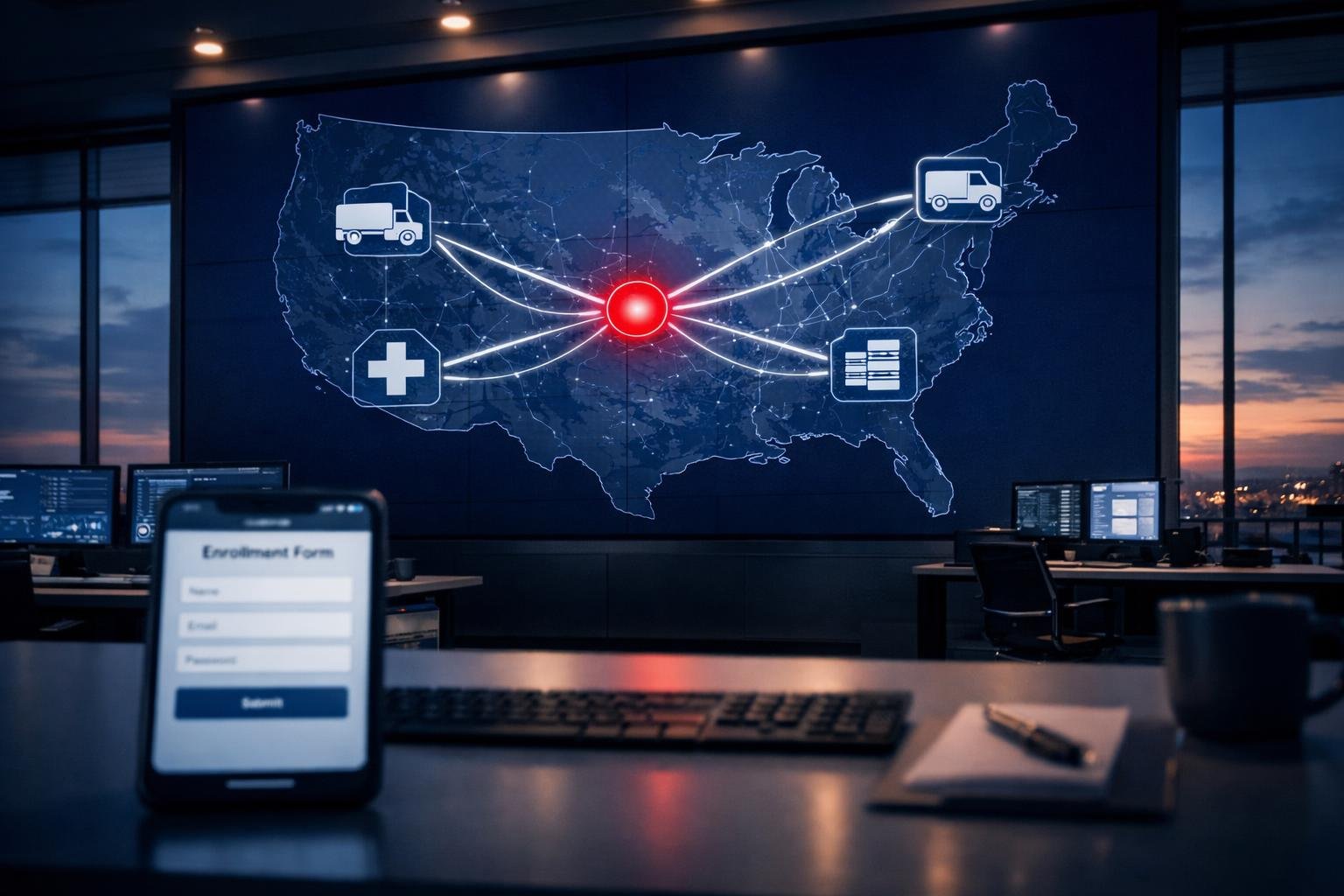
The most valuable specialty in commercial insurance right now is not an industry. It is a workforce. For decades an agency built its edge by owning a vertical: trucking, healthcare, construction, professional services. That map still works for property and liability. It is quietly breaking down for 1099 workforce coverage, because the independent contractor does not respect the vertical. The same 1099 engagement model shows up on an over-the-road carrier’s roster, a home health agency’s per-visit nurses, a delivery service partner’s driver pool, and an IT consultancy’s rotating engineer bench. Different SIC codes. One workforce type. One coverage question.
Here is the operator’s read on where this goes: by 2027 the agencies growing fastest in this line will describe their book by workforce type, not by industry, and the rails underneath them are what make that possible.
The vertical map was drawn for a W-2 economy
Insurance distribution organized itself around industries because risk used to live in the industry. A motor carrier’s exposure lived in its trucks. A hospital’s exposure lived in its building and its payroll. Agencies specialized accordingly, and carriers built appetites to match, one class code at a time. It was a sensible map for the economy it was drawn on.
The 1099 economy moved the exposure. When a business builds its output on independent contractors, the coverage question is no longer “what industry is this?” It becomes “who is doing the work, on what terms, and what coverage travels with them on the job?” That question reads the same across a trucking terminal in Texas, a telehealth staffing firm in Arizona, and a last-mile fleet in Ohio. The industries are strangers to each other. The workforce is identical.
Workers’ Comp is for W-2 employees. The WORK Program is for the 1099 economy. They are legally distinct tools for legally distinct workforces. Once you see the line that way, the vertical stops being the organizing principle for 1099 workforce coverage. The workforce is.
What 1099 workforce coverage looks like when it is built around the worker
A program organized around workforce type behaves differently from a program organized around class codes. From the agency’s seat, three things change.
One appetite across the sectors that actually run on 1099 labor
Over-the-road owner-operators. Last-mile and install contractors. Per-diem and travel clinicians. IT and professional services benches. Courier and logistics pools. One program, one set of eligibility rules, one underwriting posture. We do not write high-risk manual trades like roofing, and we say so up front. Inside the appetite, a trucking-specialized agency and a general P&C shop are writing the same product on the same rails.
One application, phone-first, bound in hours
The participant completes a five-minute application on a phone. The Account Owner enrolls from the same co-branded storefront. Quote and bind happen in hours, not days, whether the roster is drivers, nurses, or engineers. There is no separate paper process per vertical because the program never had one.
One billing rail, real time, all states
Coverage bills pay-as-you-go against the live roster. No monthly premium audits, no year-end true-up. The 3% credit card and ACH processing fee passes to the insured through ePayPolicy, which turns billing into a revenue line for the agency with no new back office. And because the program is available in all states without state-by-state endorsements, a client with contractors in eleven states is one placement, not eleven.
That is 1099 workforce coverage as infrastructure. It does not care which SIC code the Account Owner carries. It cares that the workforce is independent and the roster is current.
This changes who gets to specialize
Here is the part that matters for a principal reading this on a Friday. When 1099 workforce coverage is organized by workforce type, the agency does not need a vertical to own the line. It needs a distribution rail.
A trucking agency that has placed Occupational Accident Insurance for owner-operators for fifteen years already understands the product. Under a workforce-type program, that same agency can write the home health staffing firm two exits down the highway, because the application, the billing, and the collateral are identical. The vertical knowledge that used to gate the sale is no longer the gate.
The reverse is just as true. A general commercial agency with a book of staffing firms, marketing agencies, and IT consultancies has been carrying 1099 engagement on those accounts for years without a product to put against it. With the rails in place, that agency is a 1099 specialist the day its storefront goes live. It never needed to become a trucking shop to get there.
The rails are the specialization now. A co-branded storefront with the agency’s logo, colors, and producer pre-filled on every form, live in a day. Twenty-four pieces of agency-branded, print-ready collateral delivered on day one. Phone-first applications the participant completes in five minutes. Real-time billing that scales with the client’s roster. An agency sent us a logo Tuesday morning; Tuesday afternoon their branded enrollment page was taking applications. That is what specializing by workforce looks like in practice: the rails carry the expertise, and the agency carries the relationship.
Multiple agencies are live and writing on the platform this way, and same-day onboarding is the standard, not the exception. Some came from trucking. Some came from general commercial. On the platform they look the same, because the workforce they cover is the same.
Where this is headed
Three predictions from the operator’s chair.
Agencies will report a 1099 book as its own line
Not a trucking book with some OAI in it. Not a staffing book with an add-on. A 1099 workforce book, measured by participants enrolled and Account Owners on the platform, cutting across every vertical the agency writes. Principals who track 1099 workforce coverage that way will see growth the vertical view hides, and they will staff and market against it.
Speed and billing will decide the placement, not vertical pedigree
When the product is the same across sectors, the client compares the experience: how fast the roster gets covered, how the billing lands, whether the certificate shows up on a phone. The agency with the fastest rail keeps the account. The agency with the deepest vertical résumé and a paper application does not. That is already true in trucking, where multiple carriers are competing on bind time, and it is spreading to every sector that runs on 1099 labor.
Program providers and agencies will split the work cleanly
The provider builds and runs the rails: storefront, application, billing, collateral, all-states availability, and a documented paper trail of contractor independence sitting quietly in the background. The agency owns the front: the brand, the client, the producer relationship, the renewal conversation. That split is already how the fastest-growing agencies on our platform distribute 1099 workforce coverage, and it is the shape the whole line is moving toward. We are the program provider. The agency is the distributor. Neither one is trying to do the other’s job.
What to do with this on Monday
Look at your book by workforce type for one hour. Pull the accounts with sustained 1099 engagement wherever they sit in your vertical map: the carrier, the staffing firm, the consultancy, the delivery partner, the home health agency. If you want a fast way to surface them, run the 1099 exposure scan against your commercial list and see how much of your existing book already runs on independent labor.
Then decide whether you want to be the agency whose 1099 workforce coverage runs on a rail, or the one still routing it through a vertical that was never built for it. If it is the former, get appointed or send us a message. We stand up the storefront, ship the collateral, and you are writing by workforce type this week.